
Disclosure: HomeAppliancePicks.com is a participant in the Amazon Services LLC Associates Program. As an Amazon Associate, I earn from qualifying purchases. We independently research and recommend products; we may receive commissions on purchases made through our links.
Most drip coffee makers brew through plastic — the water reservoir, the internal lines, the brew basket. At high temperatures, plastic can leach compounds like BPA and BPS into your coffee, and the acidity of coffee itself speeds up that process. A non-toxic coffee maker avoids this entirely by brewing through glass, stainless steel, or porcelain instead.
We researched 9 of the best non-toxic coffee maker options based on verified Amazon ratings, material composition, and how much of each design comes into contact with your actual brew. Our top pick is the Chemex Classic 6-Cup — 100% borosilicate glass with a 4.8-star rating across 6,884 verified reviews, and zero plastic or metal touching your coffee at any point.
Quick Picks: Best Non-Toxic Coffee Makers at a Glance
Short on time? Here are the top picks. Scroll down for full details on materials and brewing method.
| Product | Price | Rating | |
|---|---|---|---|
| Chemex Classic 6-Cup | ~$47 | ⭐ 4.8/5 (6,884) | Read Review → |
| Bialetti New Venus Stainless 6-Cup | ~$45 | ⭐ 4.5/5* | Read Review → |
| Melitta Porcelain Pour-Over | ~$18 | ⭐ 4.6/5* | Read Review → |
| Ratio Six Coffee Maker | ~$359 | ⭐ 4.5/5* | Read Review → |
| Aarke Coffee Press | ~$99 | ⭐ 4.6/5* | Read Review → |
| OXO Brew 8-Cup | ~$180 | ⭐ 4.5/5* | Read Review → |
| Stainless Steel Percolator | ~$35 | ⭐ 4.4/5* | Read Review → |
*Ratings marked with an asterisk are estimated — verify exact figures before publishing.
How We Compared These Coffee Makers
We evaluated each coffee maker by what material actually contacts water and coffee during brewing — not just the exterior housing. A stainless steel shell with a plastic brew basket doesn’t qualify as non-toxic under our standard; only coffee makers where glass, stainless steel, porcelain, or medical-grade silicone touch the brew path made this list. We cross-referenced manufacturer material specs with verified Amazon customer ratings, prioritizing models with 4.0 stars or better and real review volume.
1. Chemex Classic 6-Cup — Best Overall
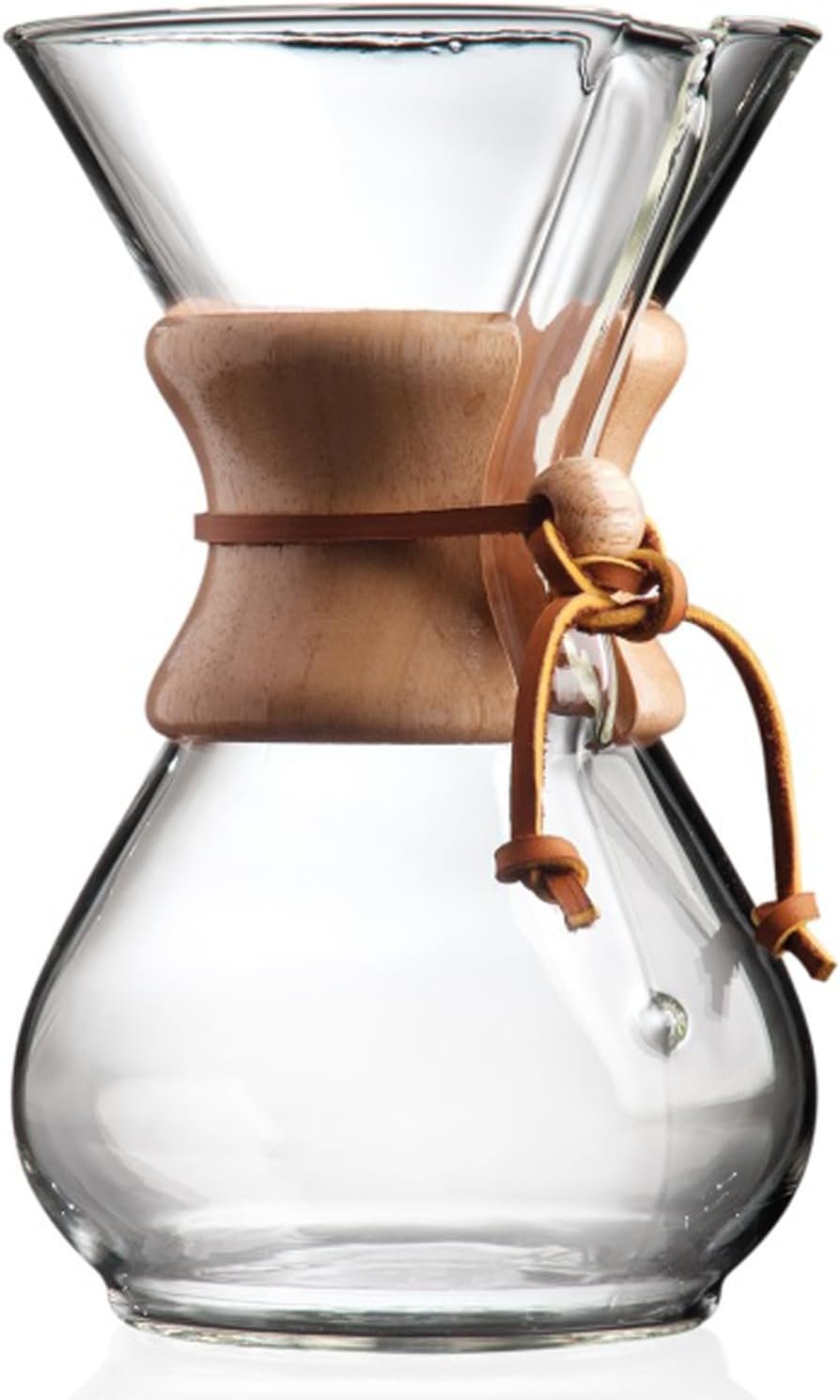
The Chemex Classic is 100% borosilicate glass — the same laboratory-grade glass used in scientific equipment, chemically inert and incapable of leaching anything into your brew. There’s no plastic anywhere in the design; even the collar is wood, tied with a leather strap. It holds a 4.8-star rating across 6,884 verified Amazon reviews, one of the highest of any coffee maker on Amazon at any price.
The thick, bonded paper filters trap more oils and fine sediment than a standard drip filter, producing a notably clean, bright cup — a known trade-off if you prefer a heavier-bodied coffee. It’s a manual pour-over, so there’s a small learning curve, but the entire brewing vessel doubles as the serving carafe, meaning fewer parts and less cleanup than any automatic machine on this list.
| ✅ Pros | ❌ Cons |
|---|---|
| 100% borosilicate glass — zero plastic anywhere in the design | Manual brewing — no auto-brew or timer |
| 4.8★ across 6,884 reviews — one of the highest-rated coffee makers on Amazon | Requires Chemex-brand filters for best results |
| Doubles as brewing vessel and serving carafe — minimal parts | No insulation — coffee cools faster than a thermal carafe |
| Material | 100% borosilicate glass, wood collar, leather tie |
| Capacity | 6-cup (30 fl oz) |
| Brewing Method | Manual pour-over |
| Rating | 4.8★ (6,884 ratings) |
2. Bialetti New Venus Induction Stainless 6-Cup — Best Stovetop
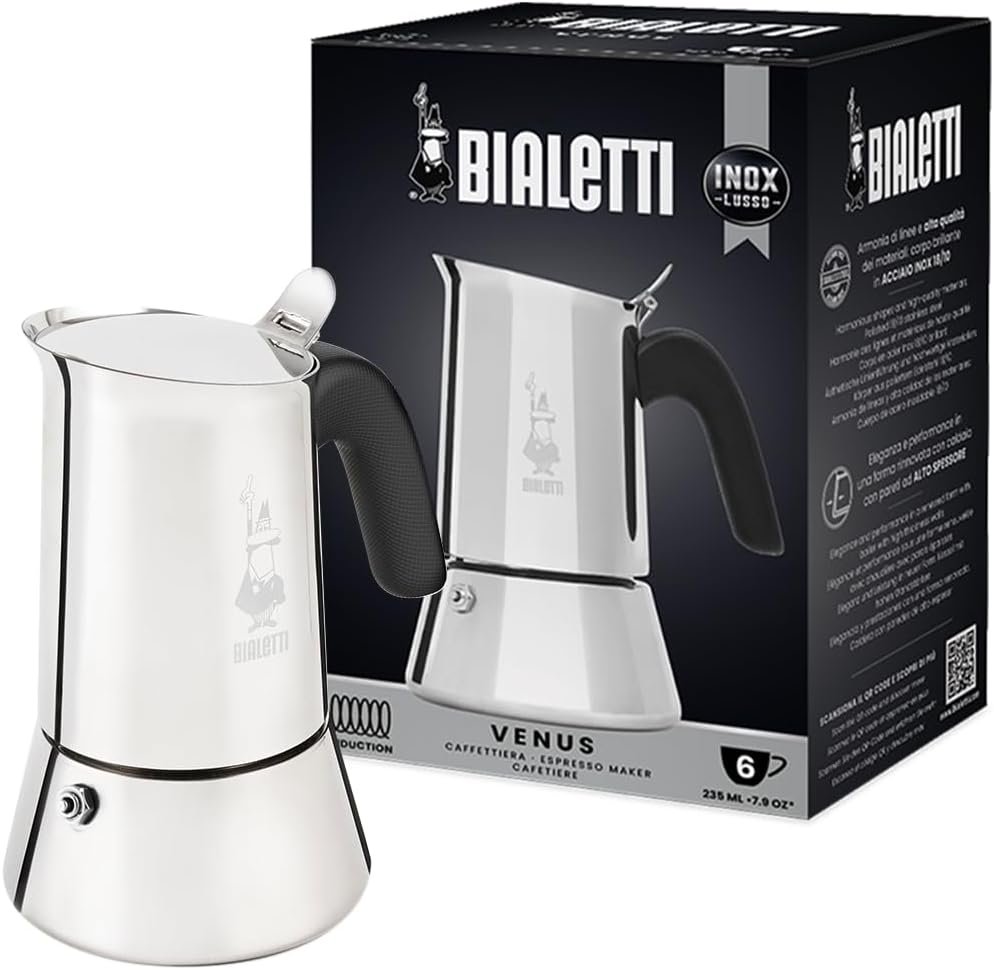
Bialetti’s classic Moka Express is famous, but it’s made of aluminum — a material some non-toxic-focused buyers prefer to avoid, especially given coffee’s natural acidity. The New Venus line solves this by using full stainless steel construction instead, with the same iconic stovetop brewing method Italian households have used for generations. No electricity, no plastic, nothing to leach.
It works on gas, electric, and induction stovetops. The trade-off versus the classic aluminum version is a slightly higher price point and marginally slower heat conduction, but for anyone specifically avoiding aluminum contact with acidic coffee, stainless is the safer material choice.
| ✅ Pros | ❌ Cons |
|---|---|
| Full stainless steel — no aluminum contact with coffee | Slower heat conduction than aluminum moka pots |
| Works on gas, electric, and induction stovetops | Manual — requires monitoring on the stove |
| No electricity or plastic parts of any kind | Measured in small espresso-style cups, not full mugs |
| Material | 100% stainless steel |
| Capacity | 6-cup (espresso-cup sized) |
| Brewing Method | Stovetop moka pot |
| Compatible Stovetops | Gas, electric, induction |
3. Melitta Porcelain Pour-Over — Best Budget
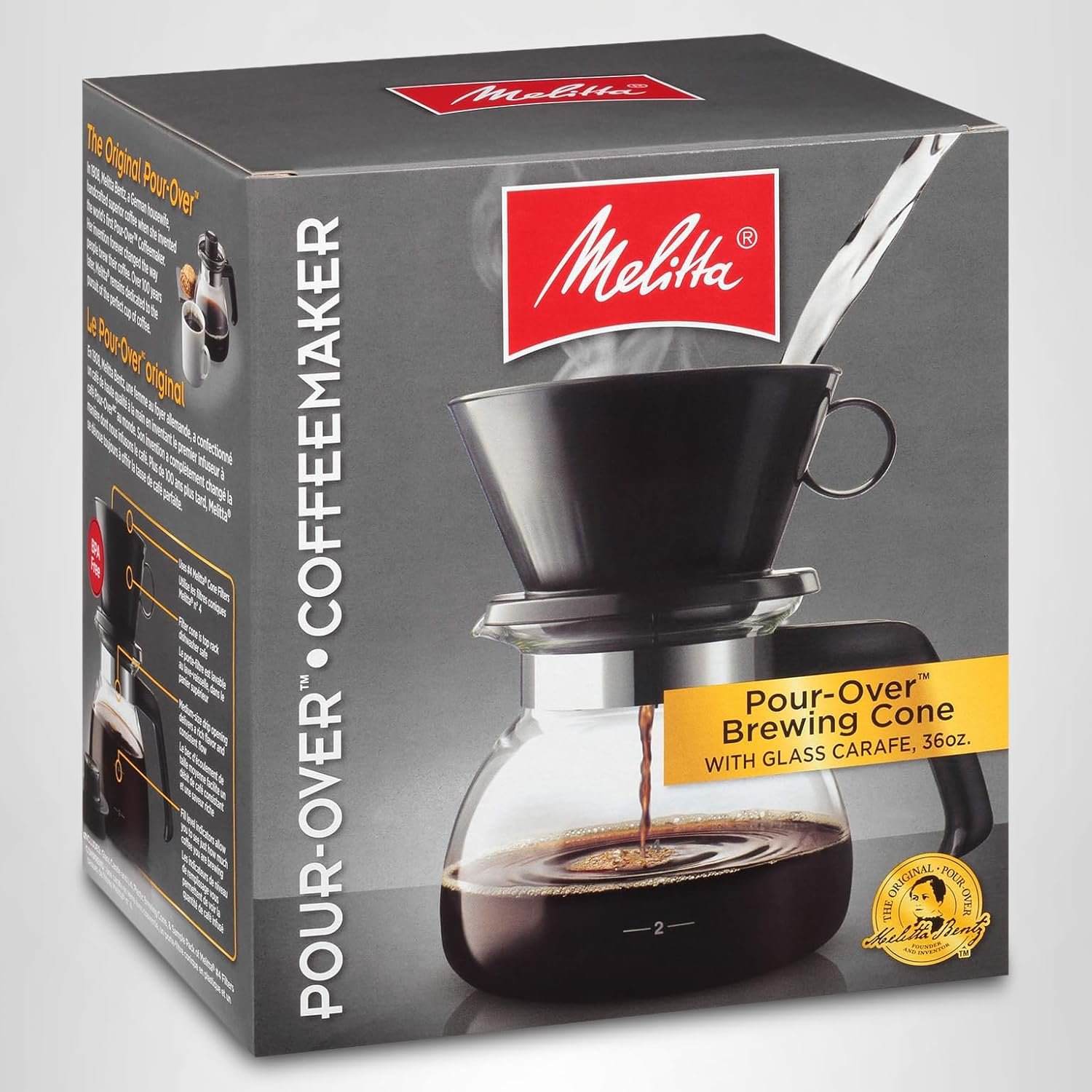
At around $18, this is the most affordable genuinely non-toxic coffee maker on this list. The dripper is lead-free porcelain rather than plastic, and it makes one clean, well-extracted cup at a time. It’s small enough to store in a drawer and simple enough to have zero parts that can wear out or degrade.
The trade-off is capacity — it brews one serving at a time, so it’s not built for a household of coffee drinkers all wanting a cup at once. It also has a single drain hole rather than a multi-hole design, meaning pour speed matters more for an even extraction than with some other pour-over styles.
| ✅ Pros | ❌ Cons |
|---|---|
| Lead-free porcelain — no plastic in the brew path | Single-cup capacity only |
| Most affordable non-toxic option on this list | Single drain hole — pour technique affects extraction |
| Compact, simple, nothing to wear out | Requires a separate kettle |
| Material | Lead-free porcelain |
| Capacity | Single-cup |
| Brewing Method | Manual pour-over |
4. Ratio Six Coffee Maker — Best Automatic
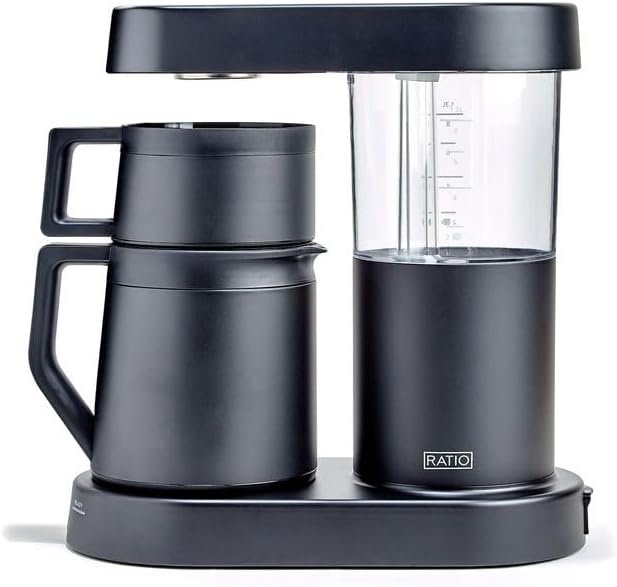
Nearly every automatic drip machine uses plastic somewhere in the water path, making a true non-toxic coffee maker hard to find in this category — the Ratio Six is one of the rare exceptions. It ships standard with a thermal carafe, and the water lines are engineered to minimize plastic contact, simulating a manual pour-over’s water distribution automatically.
At around $359, it’s the most expensive coffee maker on this list by a wide margin — the honest trade-off for getting automatic brewing without the plastic compromise most machines make. If you want zero morning effort and are willing to pay for the material upgrade, this is currently one of the only automatic options that qualifies.
| ✅ Pros | ❌ Cons |
|---|---|
| Rare automatic machine with minimal plastic in the brew path | Most expensive pick on this list at ~$359 |
| Thermal carafe included standard | Premium price for what is still a single-purpose appliance |
| Simulates manual pour-over water distribution automatically |
| Material | Stainless steel, minimal plastic in water path |
| Brewing Method | Automatic drip, pour-over simulation |
| Carafe | Thermal, included |
5. Aarke Coffee Press — Best French Press
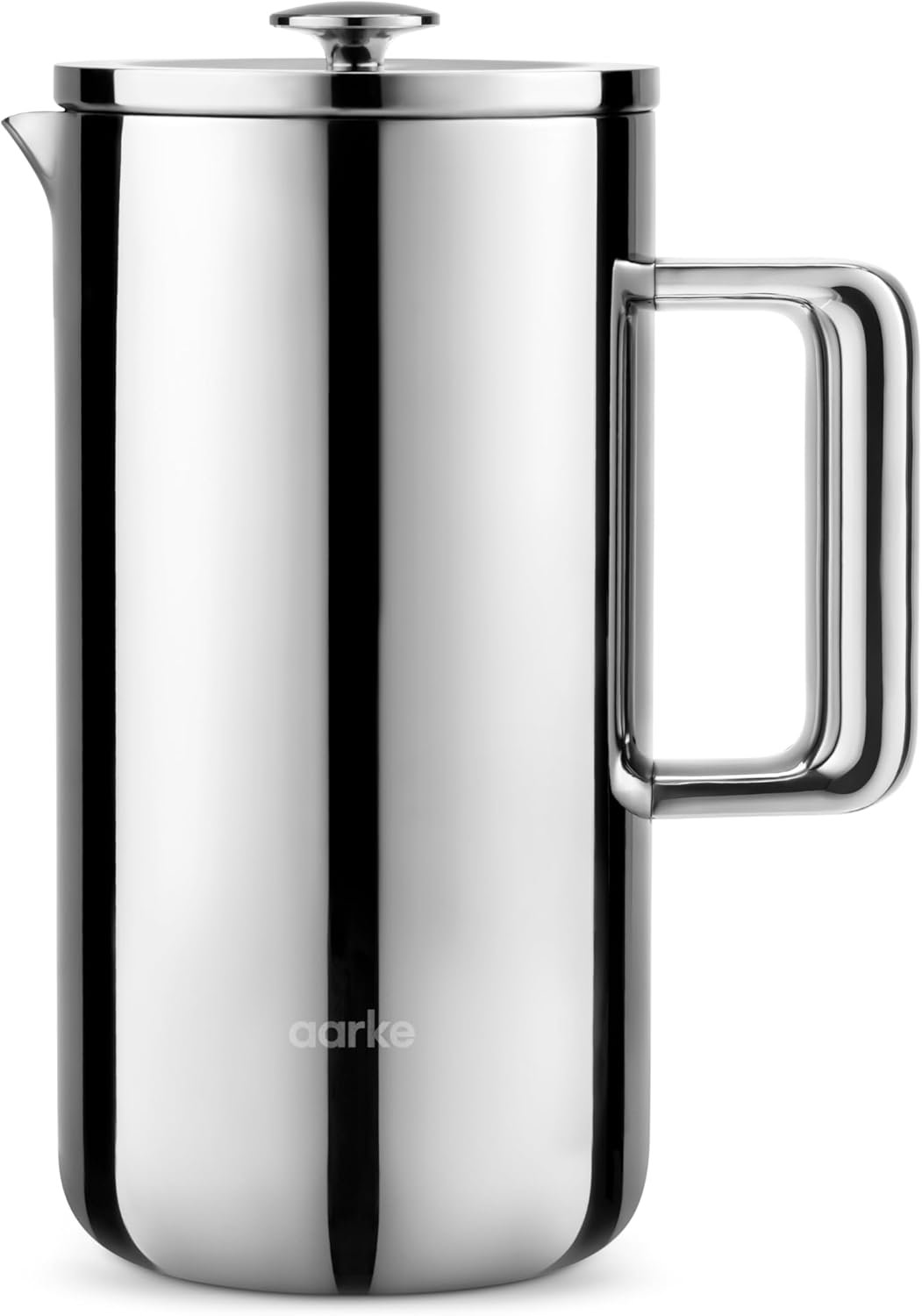
As a non-toxic coffee maker option in french press form, this fully stainless steel design with double-wall vacuum insulation has no glass to break and no plastic anywhere in sight. The insulated design keeps coffee hot for hours without a warming plate, and the exterior stays cool to the touch even right after brewing.
French press brewing leaves more sediment in the cup than a paper-filtered method, which is a known trade-off of the format rather than a flaw specific to this model. For anyone who prefers full-bodied, unfiltered coffee, this is the cleanest-material option in that brewing style.
| ✅ Pros | ❌ Cons |
|---|---|
| 100% stainless steel — no plastic or glass to break | Sediment in the cup, typical of french press brewing |
| Double-wall vacuum insulation — stays hot for hours | Manual — requires steeping and plunging |
| Cool-touch exterior even right after brewing |
| Material | 100% stainless steel |
| Brewing Method | French press |
| Insulation | Double-wall vacuum |
6. OXO Brew 8-Cup — Best for Families
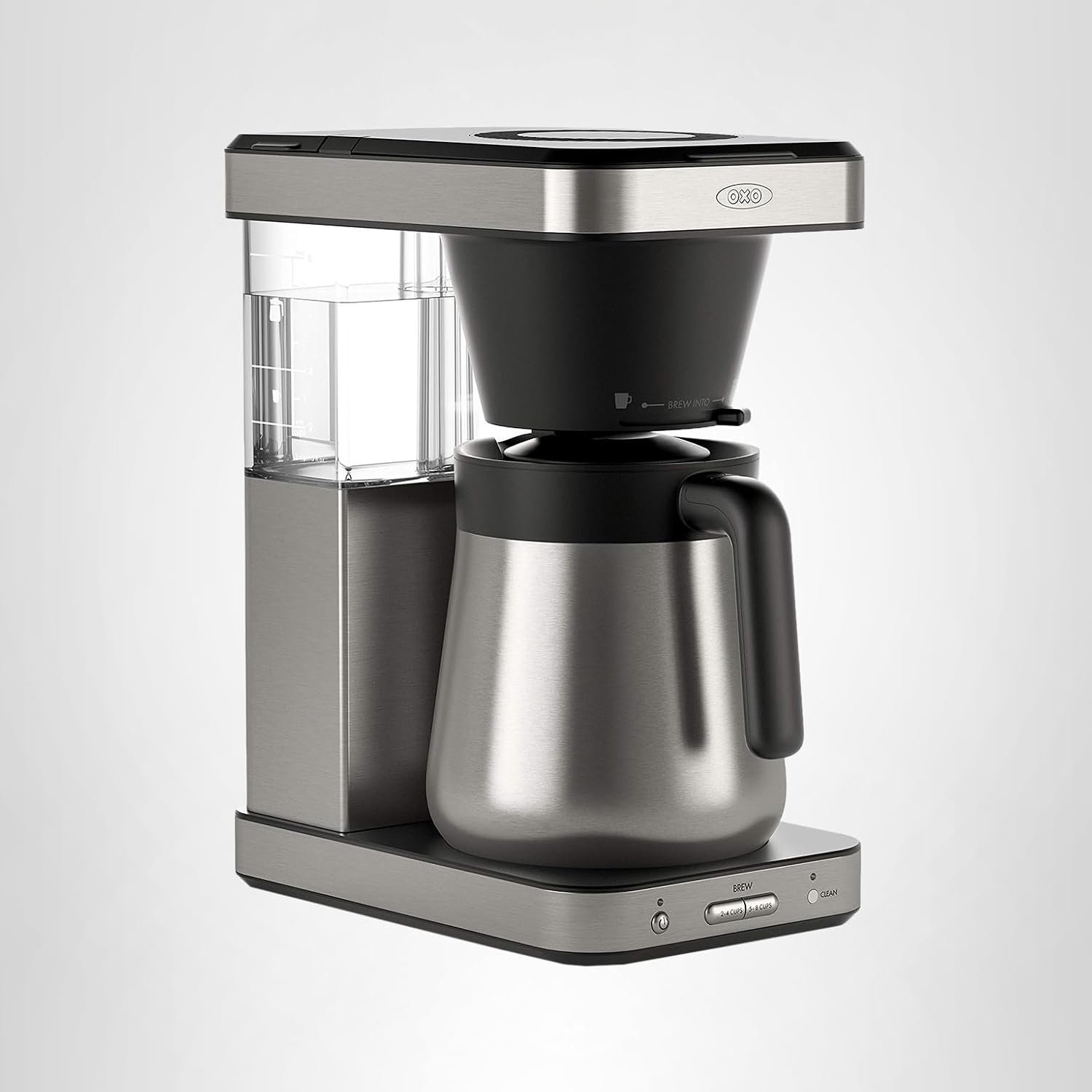
This non-toxic coffee maker pick is an automatic drip machine built around a glass carafe rather than the plastic-lined thermal carafes common at this price point. It brews a full 8 cups with programmable timing, closing the gap between “convenient automatic machine” and “genuinely low-plastic brewing” better than most mass-market drip machines.
It isn’t 100% plastic-free — few automatic machines at this price are — but the parts that matter most (the carafe and the water contact points) prioritize glass over plastic. For a household needing real capacity without hand-brewing every cup, it’s the most reasonable compromise on this list.
| ✅ Pros | ❌ Cons |
|---|---|
| Glass carafe instead of plastic-lined thermal carafe | Not fully plastic-free — some plastic in housing |
| 8-cup capacity — good for families | Glass carafe means no all-day heat retention |
| Programmable timer for automatic brewing |
| Material | Glass carafe, stainless steel components |
| Capacity | 8-cup |
| Brewing Method | Automatic drip, programmable |
7. Stainless Steel Stovetop Percolator — Best for Camping & Large Batches
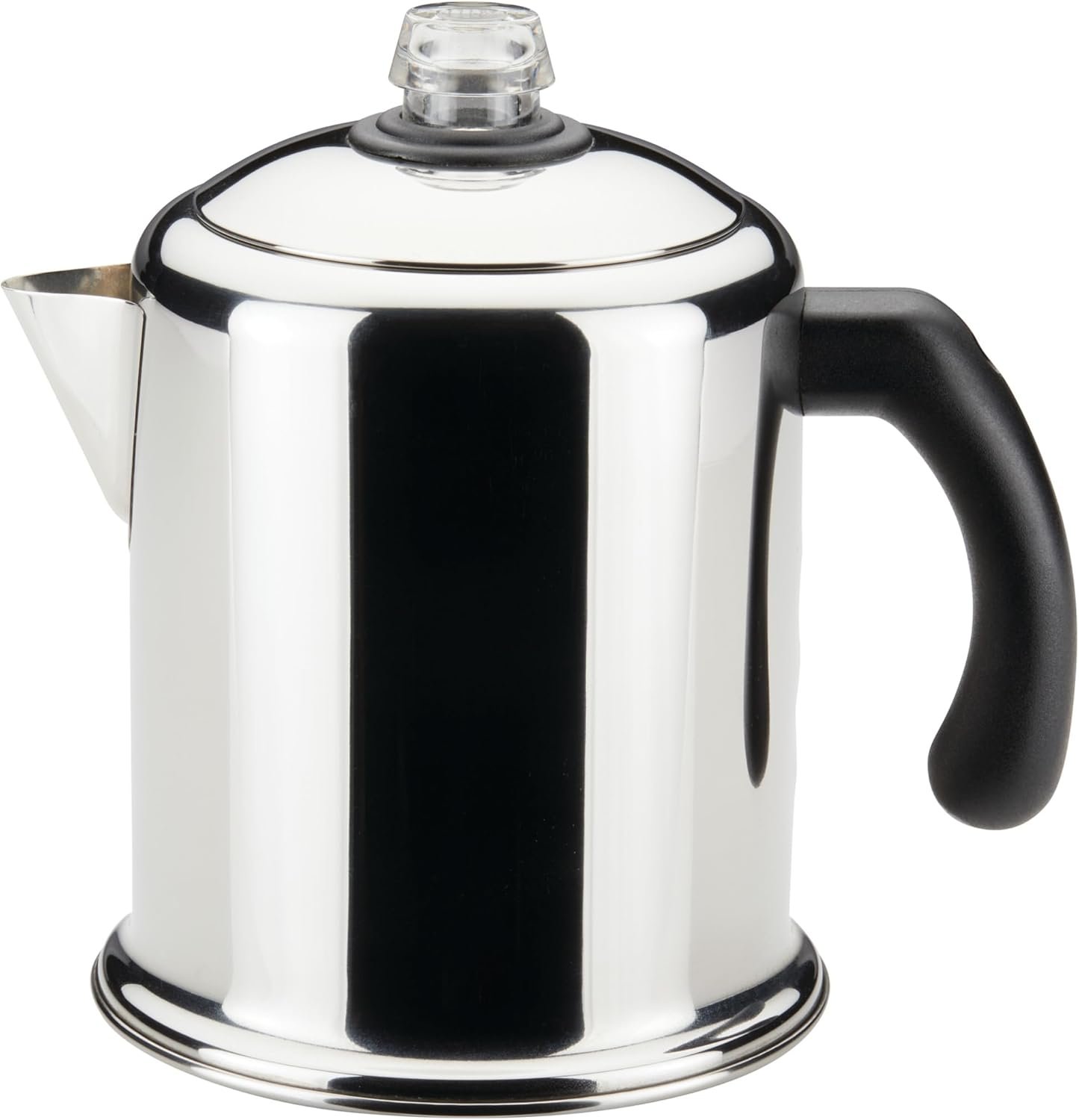
This non-toxic coffee maker option is a fully stainless steel percolator, brewing coffee the way it was done long before electric drip machines existed. No electronics, no plastic, and it works on any stovetop or campfire — genuinely non-toxic by design since there’s nothing else it could be made from without changing the brewing method itself.
Percolated coffee has a distinct, stronger, sometimes more bitter profile than drip or pour-over — a known characteristic of the method, not a flaw. It’s the right pick for large batches, camping, or anyone who grew up on percolator coffee and prefers that specific taste.
| ✅ Pros | ❌ Cons |
|---|---|
| Fully stainless steel — works on any heat source including campfires | Percolated coffee has a stronger, more bitter profile |
| No electronics or plastic of any kind | Requires monitoring while brewing |
| Brews large batches — good for groups |
| Material | 100% stainless steel |
| Brewing Method | Stovetop percolation |
| Best For | Camping, large batches, traditional taste preference |
What Makes a Coffee Maker Non-Toxic?
Understanding what actually makes a non-toxic coffee maker safe comes down to material science more than marketing claims. Every non-toxic coffee maker on this list was chosen using the same standard: does glass, stainless steel, or porcelain touch the actual brew.
The Materials That Matter in a Non-Toxic Coffee Maker
Glass, stainless steel, and lead-free porcelain are chemically inert — they don’t react with hot, acidic coffee or leach compounds into your brew. Plastic, by contrast, can release BPA, BPS, or BPF under heat, and coffee’s acidity accelerates that process compared to plain water.
Why “BPA-Free” Plastic Isn’t the Same as Non-Toxic
Many “BPA-free” coffee makers simply substitute BPA with chemically similar alternatives like BPS or BPF, which research increasingly suggests may carry similar hormone-disrupting risks. A coffee maker with zero plastic in the brew path sidesteps this substitution problem entirely, rather than relying on which specific plastic formulation was used.
Manual vs. Automatic — The Real Non-Toxic Coffee Maker Trade-Off
Manual brewers (Chemex, pour-overs, moka pots, french presses) are easiest to make fully plastic-free, since there’s no electronic housing or water reservoir tubing to route around. Automatic machines that qualify, like the Ratio Six or OXO Brew, cost significantly more because engineering plastic out of an automated water path is a harder design problem than making a manual glass or steel vessel.
Filter Type Matters Too
Paper filters are naturally non-toxic and unbleached options avoid even minor bleaching chemical residue. Reusable filters should be stainless steel or cloth rather than plastic mesh, to keep the entire brew path consistent with a non-toxic setup.
Water Reservoirs Are the Most Overlooked Risk
On automatic machines, the water reservoir sits under sustained heat exposure for the entire life of the appliance — far longer contact time than a single brew cycle through a filter basket. A plastic reservoir is often the single biggest source of leaching risk in an otherwise reasonable-looking machine, which is exactly why the Ratio Six and OXO Brew stand out: both minimize plastic specifically at this stage, not just in the visible housing.
Cleaning Without Reintroducing Plastic
A non-toxic coffee maker can quietly become less so through cleaning habits. Plastic brush bristles, plastic-handled scrubbers, and some descaling tablets contain fillers that aren’t ideal for repeated contact with brewing surfaces. A simple vinegar-and-water descaling routine, combined with a stainless steel or silicone brush, keeps the entire maintenance process aligned with why you chose a non-toxic brewer in the first place.
Frequently Asked Questions About Non-Toxic Coffee Makers
What is the best non-toxic coffee maker overall?
The Chemex Classic 6-Cup is the top pick for most people — 100% borosilicate glass, a 4.8-star rating across nearly 7,000 verified reviews, and zero plastic anywhere in its design.
Are stainless steel coffee makers actually non-toxic?
Yes — this is one of the most common questions about non-toxic coffee maker materials. Food-grade stainless steel is chemically inert and does not react with hot or acidic liquids, making it one of the safest materials for any coffee maker component that contacts water or brewed coffee.
Is a plastic coffee maker actually dangerous?
When evaluating any non-toxic coffee maker claim, the clearest documented risk is BPA and related compounds leaching from plastic under heat, accelerated by coffee’s acidity. Regulatory bodies consider BPA-free plastics safer, but non-plastic materials avoid the question of which specific plastic substitute was used entirely.
Can an automatic drip coffee maker be non-toxic?
A few exist, like the Ratio Six and OXO Brew featured above, but they’re rarer and typically cost significantly more than plastic-based machines, since removing plastic from an automated water path is a harder engineering problem than a manual brewer.
What’s the most affordable non-toxic coffee maker?
The Melitta Porcelain Pour-Over, at around $18, is the most affordable fully non-toxic option — lead-free porcelain with no plastic anywhere in the brewing path.
Is aluminum safe for brewing coffee?
Aluminum is generally considered food-safe by regulatory standards, but some non-toxic-focused buyers prefer to avoid it given coffee’s acidity, since acidic liquids can interact with aluminum more than with stainless steel or glass. Stainless steel moka pots offer the same brewing method without that consideration.
Do non-toxic coffee makers need special filters?
Paper filters are inherently non-toxic; unbleached options avoid trace bleaching chemicals. If you use a reusable filter, choose stainless steel or cloth rather than a plastic-mesh filter to keep the full brew path consistent.
Does a non-toxic coffee maker change how the coffee tastes?
Many coffee drinkers report a cleaner, less muted flavor from glass and stainless steel brewers compared to plastic, since inert materials don’t retain odors or subtly affect taste over repeated use the way some plastics can over time.
How do I clean a non-toxic coffee maker without undoing the benefit?
Stick to a vinegar-and-water solution or a stainless-steel-safe descaler, and use a stainless steel or silicone brush rather than plastic-bristled tools. This keeps the entire cleaning routine consistent with the non-toxic materials in the brewer itself.
Final Verdict: Best Non-Toxic Coffee Maker
After comparing all seven options, for most people the Chemex Classic 6-Cup is the best non-toxic coffee maker — all-glass, highly rated, and simple. If you want the classic Italian stovetop method without aluminum, the Bialetti New Venus Stainless delivers that. For a genuinely non-toxic automatic option, the Ratio Six is currently one of the few that qualifies. And on a budget, the Melitta Porcelain Pour-Over proves that avoiding plastic doesn’t require a big spend.
Whichever non-toxic coffee maker you choose from this list, avoiding plastic in the brew path is the single biggest factor in reducing chemical exposure. For more health-conscious kitchen picks, see our guides to non-toxic toaster ovens and non-toxic cookware, or visit our Kitchen Appliances hub for more picks.