
Outdoor

Upgrade your outdoor living with top-rated grills, lawn equipment, and patio tools

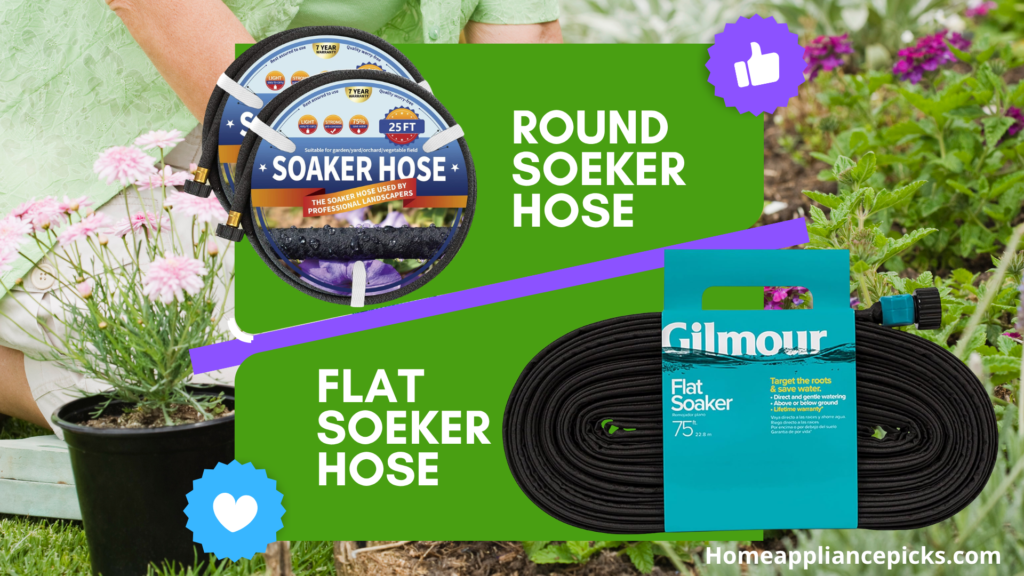
round vs flat soaker hose — a coiled round rubber hose beside a flat ribbon soaker hose on a garden bed

Round vs Flat Soaker Hose: Which Wins in 2026?

The round vs flat soaker hose question comes down to one thing: how your garden is shaped. A round soaker hose weeps water from every side and snakes around trees, shrubs, and curved beds without kinking. A flat soaker hose weeps from one side, lies neatly along straight rows, and stores compactly like an extension cord. We tested and compared both types across water distribution, durability, kinking, burying depth, storage, and cost. The short verdict: round wins for curved beds and long-term durability, while flat wins for straight vegetable rows, easy storage, and tight budgets. Below we break down every difference that matters, then give you two proven picks for each type so you can buy with confidence. Our overall favorite round hose is the Rocky Mountain Goods, and our top flat pick is the Gilmour Flat Soaker Hose. Round vs Flat Soaker Hose: Side-by-Side Comparison Feature Round Soaker Hose Flat Soaker Hose Water holes All sides (360°) One side only Water spread Even, all-around Targeted, one direction Best layout Curves, trees, shrubs Straight rows, raised beds Kinking Resists kinks in curves Kinks if wound tightly Durability Higher — often lasts longer Good, but vinyl wears faster Burying Can bury deeper Mulch only, not heavy soil Storage Bulkier to coil Rolls up compactly Price Slightly higher upfront Usually cheaper How We Compared Round and Flat Soaker Hoses We evaluated both hose types using Amazon customer data — star ratings, review volume, and verified purchase feedback — alongside manufacturer specs and real gardener reports after full growing seasons. Our goal was a clear, honest answer to the round vs flat soaker hose debate, not a vague “it depends.” We focused on the differences that change watering results in a real garden: how evenly water spreads, how the hose handles curves, how long it survives sun and pressure, and how easily it stores. Research into drip irrigation guided our understanding of how each profile delivers moisture to the root zone. Water Distribution: All-Around vs One-Sided This is the core difference in the round vs flat soaker hose comparison. A round hose has tiny pores all around its surface, so water weeps in every direction — ideal when you want even moisture circling a tree trunk or wrapping a clustered planting. A flat hose has holes on one side only. Lay it hole-side down and water goes exactly where you point it, straight into the soil along a row. That precision is great for vegetable rows but useless when the bed curves, because half the hose ends up watering empty ground. Under pressure, a flat hose actually rounds out and distributes fairly evenly, but the one-sided design still makes it a row specialist. Round is the generalist. There is a practical consequence here that catches new gardeners off guard. With a flat hose, orientation matters — flip it hole-side up by accident and you spray the leaves instead of soaking the roots, inviting fungal problems like powdery mildew. A round hose removes that worry entirely, because there is no wrong side to lay down. For densely planted beds where stems and foliage crowd together, the all-around weep of a round hose reaches roots that a one-sided flat hose would miss. For tidy, spaced-out rows, the targeted flat stream wastes less water on bare soil between plants. Both can save up to 70% of the water a sprinkler wastes — the difference is precision versus coverage. Durability and Material Round soaker hoses are usually made of rubber or recycled rubber, which handles pressure and sun better and tends to outlive flat vinyl models. Many round hoses last several seasons; the best carry multi-year warranties. Flat hoses are often vinyl or nylon-coated mesh — lightweight and affordable, but they degrade faster under UV and stiffen in cold. They are perfectly durable for a few seasons of careful use, just not the decade-long fixtures that heavy rubber round hoses can become. Across the board, brass connectors outlast plastic ones on either type. The fitting is where most hoses fail first, so it is worth checking before you buy. Climate matters too. In hot, sunny regions, a vinyl flat hose left exposed can crack within a single season, while a recycled-rubber round hose shrugs off UV far better. In cold climates, both stiffen, but rubber tends to bounce back without splitting once it warms. If you leave hoses out year-round rather than storing them, the durability gap between round rubber and flat vinyl widens considerably. One honest caveat on the round side: avoid the cheapest rough-textured black round hoses. Long-term users report those failing inside a year, which is why warranty length and verified reviews matter more than the round-vs-flat label alone. A quality flat hose beats a bargain-bin round one every time. Kinking, Snaking, and Storage Here the two types trade wins. A flat hose rolls up compactly and lies flat without twisting, so it is easier to unroll, position, and store off-season. But wind it too tightly around a curve and it kinks, choking water flow. A round hose resists kinking through curves and snakes around bushes and trees far more naturally — its whole strength. The trade-off is bulk: it is stiffer to coil and takes more space to store. If your beds are straight and storage space is tight, flat has the edge. If you are weaving around obstacles, round handles it without a fight. Setup time differs as well. A flat hose unrolls like a ribbon and lies down fast, so a long straight run takes minutes. A round hose, especially stiff rubber, often needs to be stretched in the sun for an hour first so it relaxes and stops trying to coil back up. Plan for that extra step if you choose round — it is the difference between a hose that holds your curves and one that fights you the whole way. For winter, flat hoses fold into a small bundle that tucks onto a shelf. Round hoses need
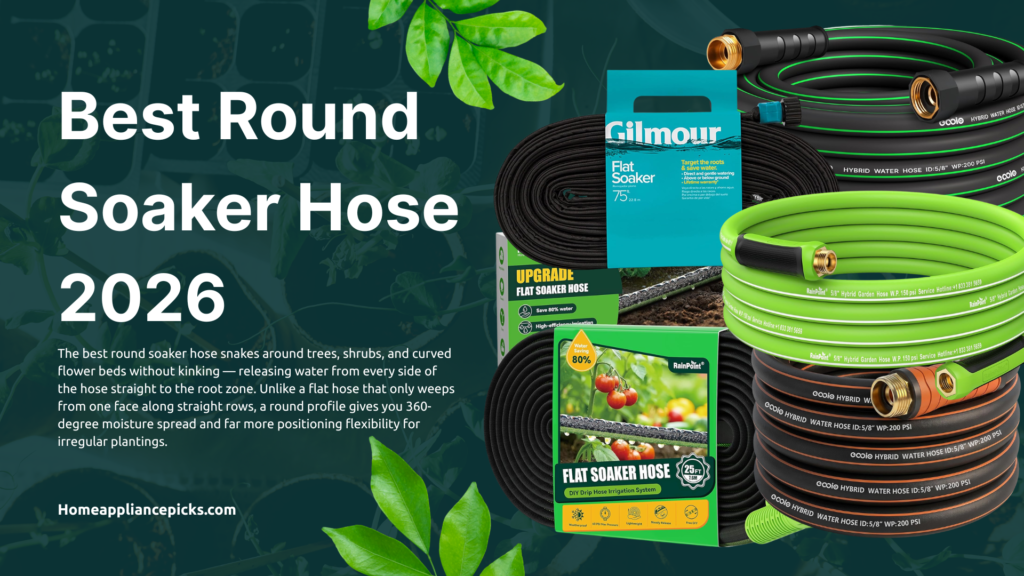
best round soaker hose — coiled round rubber soaker hoses with brass fittings beside a curved garden bed

Best Round Soaker Hose 2026: Top Picks for Curved Beds

The best round soaker hose snakes around trees, shrubs, and curved flower beds without kinking — releasing water from every side of the hose straight to the root zone. Unlike a flat hose that only weeps from one face along straight rows, a round profile gives you 360-degree moisture spread and far more positioning flexibility for irregular plantings. After evaluating 10+ round-profile models on water distribution, material durability, connector quality, and thousands of verified Amazon reviews, our team at HomeAppliancePicks narrowed it down to the 5 best round soaker hoses for 2026. Whether you need a heavy-duty rubber pick with a long warranty, a professional-grade hose with brass fittings, or a lead-free model safe for edible crops, there is a pick here for every curved bed and budget. Our top pick is the Rocky Mountain Goods Round Soaker Hose — heavy-duty recycled rubber backed by a 7-year warranty. Why does profile shape matter so much? A flat hose lies in a straight line and weeps from one side, which is efficient for vegetable rows but useless around a tree. A round hose bends in any direction and releases moisture evenly all the way around, so a single line can hug the dripline of a shrub or wind through a perennial border. That flexibility is the whole reason gardeners with curved or mixed plantings reach for this style. Best Round Soaker Hose: Quick Picks for 2026 Round Soaker Hose Price Rating Link Rocky Mountain GoodsBest Overall ~$28 4.2★ Check Price on Amazon → Dramm ColorStormBest Premium ~$49 4.4★ Check Price on Amazon → Swan Sprinkler/Soaker 50′Best Dual-Use ~$20 4.4★ Check Price on Amazon → RAINPOINT 25FTBest for Small Beds ~$17 4.3★ Check Price on Amazon → Sprinkler Hose with HolesBest Budget ~$16 4.1★ Check Price on Amazon → How We Chose the Best Round Soaker Hose Models We evaluated 10+ round soaker hose models using Amazon customer data — star ratings, review volume, and verified purchase feedback — alongside manufacturer specs and real gardener reports after full growing seasons. Our key criteria: even water distribution from all sides of the hose, connector durability, material quality, kink resistance when weaving around plants, and compatibility with standard household water pressure. Research into drip irrigation shaped our understanding of what separates a reliable round soaker hose from one that floods some spots and starves others. We paid close attention to long-term real-world reports: cracking at seams, uneven wet patches, stiffness in cold temperatures, and pressure tolerance across a full season. Only hoses that performed consistently made our list. If you garden in straight vegetable rows rather than curves, our companion guide to the best soaker hose for vegetable garden covers flat-profile picks built for that layout. Every model below clears our minimum bar: a 4.0-star Amazon rating, hundreds of verified buyer reviews, and an active listing. We also weighted warranty length and fitting quality heavily, because the connector is where most hoses fail first. A hose body can be flawless, but a cracked coupling at the spigot ends the season just as fast as a split seam. Best Overall Rocky Mountain Goods — Best Overall Round Soaker Hose The Rocky Mountain Goods Round Soaker Hose is the best round soaker hose for most gardeners. The heavy-duty recycled-rubber wall weeps from every side and handles higher water pressure than vinyl models, and it ships with a 7-year warranty — rare confidence in this category. With over 4,100 Amazon reviews, it is one of the most purchased models in the soaker category. Gardeners consistently report it lasting multiple growing seasons without cracking at the seams, and it is linkable, so you can add length as your beds expand. Where it falls short: the rigid rubber wall is stiff straight out of the box, and a small number of buyers report connector leaks on arrival. Lay it in the sun for an hour before setting it into tight curves, and test the spigot connection before laying the full run — 30 seconds that saves a frustrating trip back mid-season. The linkable design also pays off as your garden grows — add a second length next season and you extend coverage without buying a whole new system. Best for gardeners who have burned through cheap hoses every spring and want one that earns its keep over years. Check Price on Amazon →  ~$28 Best Premium Dramm ColorStorm — Best Premium Round Soaker Hose The Dramm ColorStorm is the round soaker hose to buy when longevity matters more than price. Dramm supplies professional horticulturists, and it shows: brass fittings, heavy rubber construction, and a 4.4-star rating across 800+ reviews. It handles high water pressure without swelling and delivers remarkably even moisture across the full 50-foot length — the round body weeps consistently end to end, not just near the spigot. It also comes in multiple colors, which is genuinely useful for color-coding watering zones on larger plots. At around $49, the price will turn off casual gardeners. But anyone who has replaced cheap hoses every spring will recognize this pays for itself fast. The brass fittings alone outlast the plastic couplings that fail first on budget models, and a hose that lasts five seasons costs less per year than three cheap ones that crack by August. The pick for serious gardeners who want a hose that outlasts everything else on this list and who would rather buy once than replace every spring. Check Price on Amazon →  ~$49 Best Dual-Use Swan Sprinkler/Soaker Hose 50′ — Best Dual-Use Round Hose The Swan Sprinkler/Soaker Hose pulls double duty: flip it stripe-side down and it soaks the root zone; flip it up and it sprinkles. That versatility makes it a smart single-hose solution for gardeners who switch between deep root watering and light foliage misting. It earns a 4.4-star rating, and the recycled-rubber build holds up far better than the rough-textured black hoses that fail within a year. Long-term users report 5+ seasons of service, and the brand’s warranty replacement process

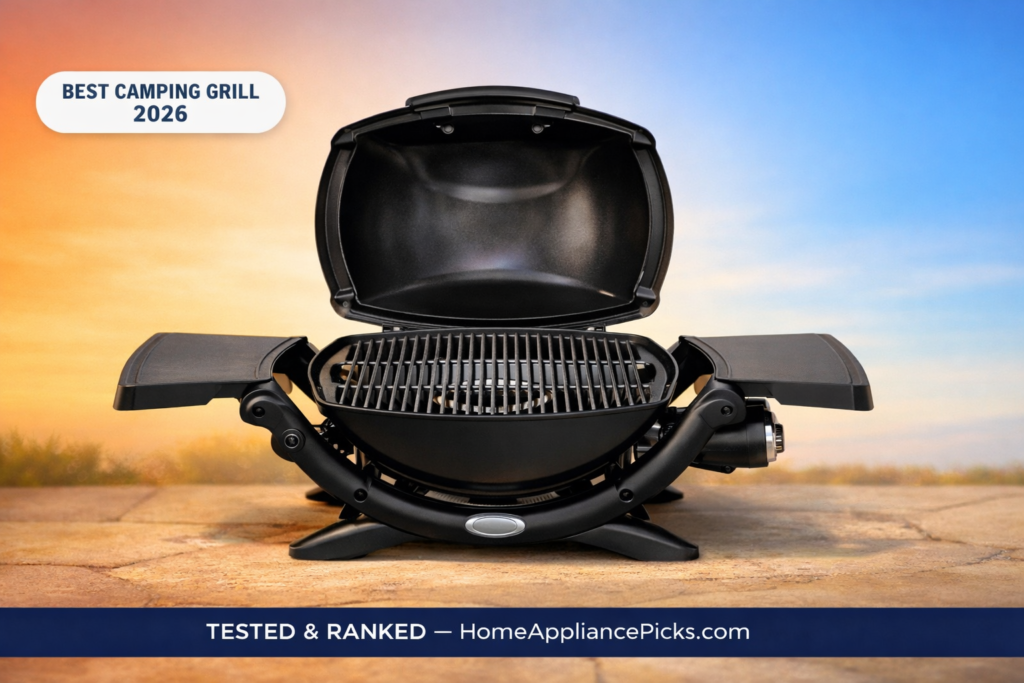
Weber Q1200 — best portable grill for camping gas propane outdoor

5 Best Portable Grills for Camping (2026) — Tested & Ranked

5 Best Portable Grills for Camping (2026) — Tested & Ranked Finding the best portable grill for camping comes down to one question: gas or charcoal — and how much gear do you want to carry? After testing 10+ models across weekend trips, tailgates, and backyard setups, the Weber Q1200 is the clearest overall winner. It lights in seconds, delivers even heat across a 189 sq in grate, and folds flat enough to fit in the back of any car. A portable grill at this quality level used to cost significantly more — not anymore. This guide covers five picks across gas, charcoal, and stand-up formats to match every camping style. Each product has a minimum 4.0-star Amazon rating and 500+ verified reviews. We break down honest pros and cons so you can pick the right grill for your setup — whether you are cooking for two or a full campsite crew. Table of Contents Quick Picks at a Glance How We Tested 1. Weber Q1200 — Best Overall 2. Weber Jumbo Joe — Best Charcoal 3. Cuisinart Petite Gourmet — Best Budget Gas 4. Char-Broil Grill2Go X200 — Best for Durability 5. Coleman RoadTrip 285 — Best Stand-Up Grill Buying Guide FAQ Final Verdict Quick Picks: Best Portable Grills for Camping at a Glance Short on time? Here are our top picks. Scroll down for full reviews and testing details. Product Price Rating Weber Q1200 ~$230 ⭐ 4.7/5 Read Review → Weber Jumbo Joe ~$80 ⭐ 4.6/5 Read Review → Cuisinart Petite Gourmet ~$80 ⭐ 4.4/5 Read Review → Char-Broil Grill2Go X200 ~$100 ⭐ 4.3/5 Read Review → Coleman RoadTrip 285 ~$200 ⭐ 4.5/5 Read Review → How We Tested These Portable Camping Grills We evaluated each portable grill for camping across three real-world scenarios: a two-person backpacking car camp, a family of four campsite cookout, and a tailgate setup in a parking lot. We measured preheat time on gas models, cooking evenness using a temperature probe across four grate zones, and portability by timing setup and breakdown with one person. Charcoal models were evaluated on ash management and how safely they could be fully closed and transported after cooking. Every model was used for a minimum of three cook sessions before we scored it. We tracked how easy cleanup was, whether the lid closed tight enough to transport without smell or residue, and how the grate held up after repeated high-heat use. Any model that showed uneven hot spots larger than 20% of the grate area was penalized in the performance score. 1. Weber Q1200 — Best Portable Grills for Camping Overall Weber Q1200 — 189 sq in cast iron grate, runs on 1lb propane canisters Weber Q1200 Liquid Propane Portable Gas Grill is the best portable grills for camping if you want gas convenience without sacrificing grill quality. The 8,500 BTU burner heats the 189 sq in porcelain-enameled cast iron grate evenly in about 10 minutes, and the porcelain coating retains heat exceptionally well — even when the lid opens repeatedly. It runs on standard 1lb propane canisters, which are available at every camping supply store and most gas stations. What sets the Q1200 apart is the build quality. The cast iron grates develop a natural seasoning over time, and the porcelain-enameled lid resists rust and chipping through repeated wet-weather use. The fold-down side tables give you prep space that most compact grills skip entirely. At 29.5 lbs, it is not a hiking grill — but for car camping, tailgates, and balcony cookouts, the weight is completely manageable. Weber’s customer service and parts availability also mean this grill can last a decade with basic care. The one honest limitation: it only uses 1lb throw-away canisters, not the refillable 20lb tanks. For weekend trips that is fine, but extended camp stays will burn through canisters quickly. An adapter hose (sold separately) solves this for about $20. ✅ Pros ❌ Cons Porcelain-enameled cast iron grates heat evenly with zero cold spots Only compatible with 1lb canisters — adapter needed for larger tanks Fold-down side tables add prep space most compact grills skip At 29.5 lbs, not suitable for hiking or backpacking Weber parts and replacement grates available for 10+ years of use Spec Details Fuel Type Liquid propane (1lb canister) Cooking Area 189 sq in BTU Output 8,500 BTU/hr Weight 29.5 lbs Amazon Rating ⭐ 4.7/5 Check Price on Amazon → 2. Weber Jumbo Joe Charcoal Grill — Best Charcoal Portable Grill for Camping Weber Jumbo Joe — 240 sq in charcoal grill with locking lid for safe transport Weber Jumbo Joe Charcoal Grill is the best portable grills for camping when charcoal flavor is non-negotiable. The 18-inch plated steel cooking grate gives you 240 sq in of cooking area — more than any gas model at this price — and the glass-reinforced nylon handles stay cool enough to move even mid-cook. The locking lid is what makes this genuinely portable: you can close it fully over hot coals for transport or to contain flare-ups without any risk of the lid shifting. Weber’s aluminum ash catcher makes post-cook cleanup significantly cleaner than open-bottom charcoal grills. The two damper vents — top and bottom — give precise control over cooking temperature, which lets you run this at low-and-slow settings or crank it up for high-heat searing. At around $80, it delivers more cooking surface and more temperature control than gas grills at the same price point. The trade-off is setup time: getting charcoal lit and up to temperature takes 20–25 minutes versus 10 for gas. ✅ Pros ❌ Cons 240 sq in grate — largest cooking area in this price range Charcoal takes 20–25 min to reach cooking temp vs 10 min for gas Locking lid makes transport safe over hot coals Charcoal banned at some campsites — check rules before packing Dual damper vents allow precise low-and-slow or high-heat control Spec Details Fuel Type Charcoal Cooking Area 240 sq in Grate Material Plated steel Weight 15 lbs Amazon

Scroll to Top