Round vs Flat Soaker Hose: Which Wins in 2026?
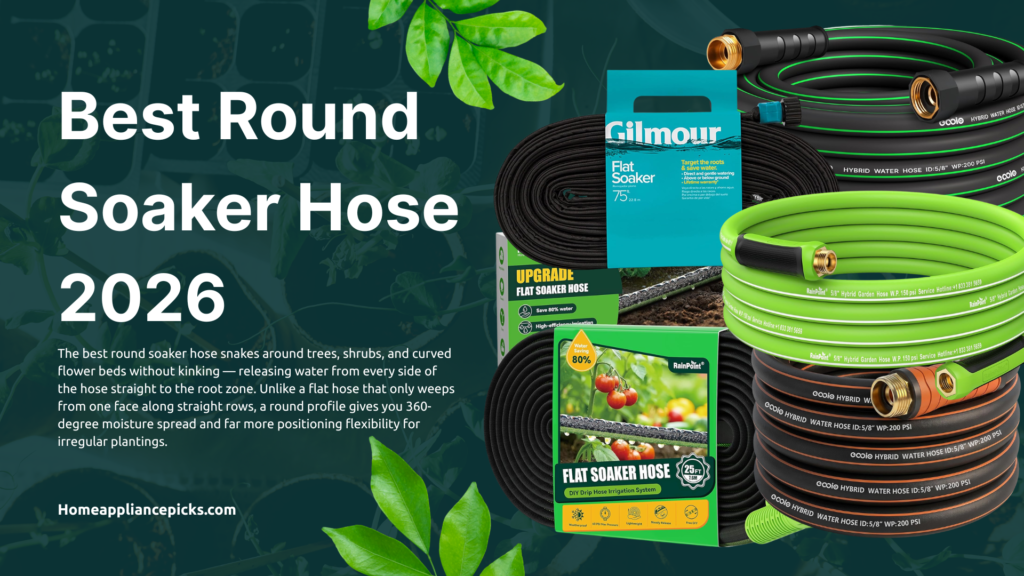
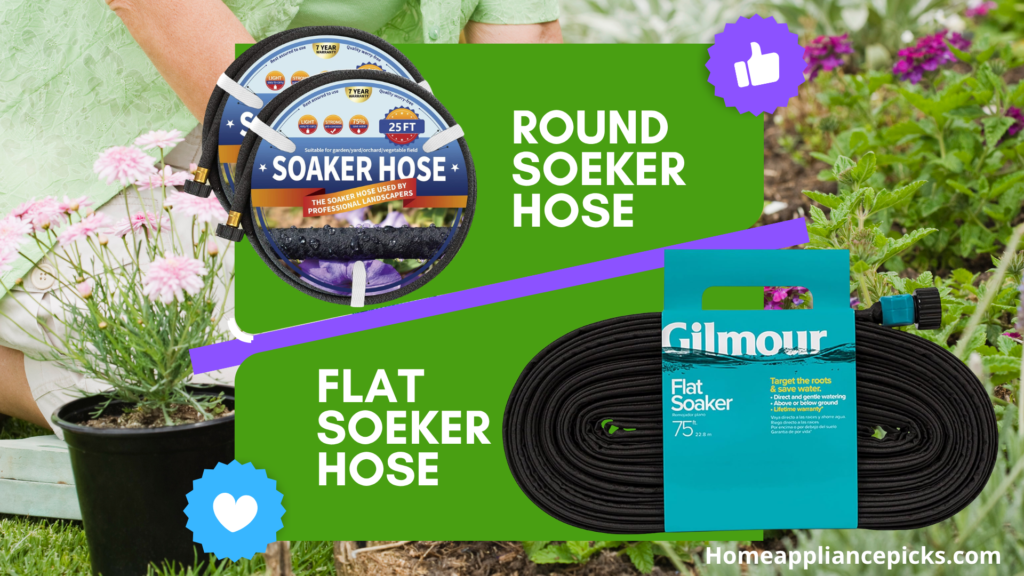
The round vs flat soaker hose question comes down to one thing: how your garden is shaped. A round soaker hose weeps water from every side and snakes around trees, shrubs, and curved beds without kinking. A flat soaker hose weeps from one side, lies neatly along straight rows, and stores compactly like an extension cord. We tested and compared both types across water distribution, durability, kinking, burying depth, storage, and cost. The short verdict: round wins for curved beds and long-term durability, while flat wins for straight vegetable rows, easy storage, and tight budgets. Below we break down every difference that matters, then give you two proven picks for each type so you can buy with confidence. Our overall favorite round hose is the Rocky Mountain Goods, and our top flat pick is the Gilmour Flat Soaker Hose. Round vs Flat Soaker Hose: Side-by-Side Comparison Feature Round Soaker Hose Flat Soaker Hose Water holes All sides (360°) One side only Water spread Even, all-around Targeted, one direction Best layout Curves, trees, shrubs Straight rows, raised beds Kinking Resists kinks in curves Kinks if wound tightly Durability Higher — often lasts longer Good, but vinyl wears faster Burying Can bury deeper Mulch only, not heavy soil Storage Bulkier to coil Rolls up compactly Price Slightly higher upfront Usually cheaper How We Compared Round and Flat Soaker Hoses We evaluated both hose types using Amazon customer data — star ratings, review volume, and verified purchase feedback — alongside manufacturer specs and real gardener reports after full growing seasons. Our goal was a clear, honest answer to the round vs flat soaker hose debate, not a vague “it depends.” We focused on the differences that change watering results in a real garden: how evenly water spreads, how the hose handles curves, how long it survives sun and pressure, and how easily it stores. Research into drip irrigation guided our understanding of how each profile delivers moisture to the root zone. Water Distribution: All-Around vs One-Sided This is the core difference in the round vs flat soaker hose comparison. A round hose has tiny pores all around its surface, so water weeps in every direction — ideal when you want even moisture circling a tree trunk or wrapping a clustered planting. A flat hose has holes on one side only. Lay it hole-side down and water goes exactly where you point it, straight into the soil along a row. That precision is great for vegetable rows but useless when the bed curves, because half the hose ends up watering empty ground. Under pressure, a flat hose actually rounds out and distributes fairly evenly, but the one-sided design still makes it a row specialist. Round is the generalist. There is a practical consequence here that catches new gardeners off guard. With a flat hose, orientation matters — flip it hole-side up by accident and you spray the leaves instead of soaking the roots, inviting fungal problems like powdery mildew. A round hose removes that worry entirely, because there is no wrong side to lay down. For densely planted beds where stems and foliage crowd together, the all-around weep of a round hose reaches roots that a one-sided flat hose would miss. For tidy, spaced-out rows, the targeted flat stream wastes less water on bare soil between plants. Both can save up to 70% of the water a sprinkler wastes — the difference is precision versus coverage. Durability and Material Round soaker hoses are usually made of rubber or recycled rubber, which handles pressure and sun better and tends to outlive flat vinyl models. Many round hoses last several seasons; the best carry multi-year warranties. Flat hoses are often vinyl or nylon-coated mesh — lightweight and affordable, but they degrade faster under UV and stiffen in cold. They are perfectly durable for a few seasons of careful use, just not the decade-long fixtures that heavy rubber round hoses can become. Across the board, brass connectors outlast plastic ones on either type. The fitting is where most hoses fail first, so it is worth checking before you buy. Climate matters too. In hot, sunny regions, a vinyl flat hose left exposed can crack within a single season, while a recycled-rubber round hose shrugs off UV far better. In cold climates, both stiffen, but rubber tends to bounce back without splitting once it warms. If you leave hoses out year-round rather than storing them, the durability gap between round rubber and flat vinyl widens considerably. One honest caveat on the round side: avoid the cheapest rough-textured black round hoses. Long-term users report those failing inside a year, which is why warranty length and verified reviews matter more than the round-vs-flat label alone. A quality flat hose beats a bargain-bin round one every time. Kinking, Snaking, and Storage Here the two types trade wins. A flat hose rolls up compactly and lies flat without twisting, so it is easier to unroll, position, and store off-season. But wind it too tightly around a curve and it kinks, choking water flow. A round hose resists kinking through curves and snakes around bushes and trees far more naturally — its whole strength. The trade-off is bulk: it is stiffer to coil and takes more space to store. If your beds are straight and storage space is tight, flat has the edge. If you are weaving around obstacles, round handles it without a fight. Setup time differs as well. A flat hose unrolls like a ribbon and lies down fast, so a long straight run takes minutes. A round hose, especially stiff rubber, often needs to be stretched in the sun for an hour first so it relaxes and stops trying to coil back up. Plan for that extra step if you choose round — it is the difference between a hose that holds your curves and one that fights you the whole way. For winter, flat hoses fold into a small bundle that tucks onto a shelf. Round hoses need