
Disclosure: HomeAppliancePicks.com is a participant in the Amazon Services LLC Associates Program. As an Amazon Associate, I earn from qualifying purchases. We independently research, test, and recommend products; we may receive commissions on purchases made through our links.
The short answer to the question is ceramic cookware safe: most ceramic cookware is safer than traditional Teflon — but “ceramic cookware safe” is not a blanket guarantee. The concern is not ceramic itself. It is what ceramic-coated pans are built around — and what happens to that coating over time. A 2025 study found that scratched non-stick coatings — a critical concern for anyone asking is ceramic cookware safe — can release up to 2.3 million microplastic and nanoplastic particles into food per cooking session. The question is whether the ceramic coating on your pan falls into the safe category or the misleading-marketing category. After researching 20+ pans and analyzing material safety data, we found that ceramic cookware safe status depends entirely on what the coating is made of, how it is applied, and what certifications back the claim.
Here is what most ceramic cookware safe guides skip: “PFOA-free” on a label does not mean the pan is free from all forever chemicals. The US banned PFOA from manufacturing in 2013 — so every pan made since then is technically PFOA-free. What they do not tell you is whether the pan still contains PTFE (Teflon) or other PFAS compounds that have replaced PFOA. A Consumer Reports survey found 65% of US adults are now concerned about PFAS in their cookware — and for good reason. The safest ceramic cookware is the kind made without any synthetic fluoropolymer coating, from brands that publish third-party lab testing to prove it.
Our top pick is the GreenPan Valencia Pro — it uses Thermolon ceramic coating, is free from PTFE, PFOA, PFAS, lead, and cadmium, and has been independently verified by one of the most respected ceramic coating manufacturers in the market. Here are the 5 safest picks we found for 2026, with full material breakdowns for each.
What Makes Non-Stick Cookware Unsafe? Understanding the Materials
Before the ceramic cookware safe picks, here is what you actually need to know about the materials to avoid — and why the marketing labels on most pans are designed to confuse rather than inform.
PFAS — The “Forever Chemicals” Family
PFAS (per- and polyfluoroalkyl substances) is a family of over 12,000 synthetic chemicals used to make surfaces water and oil resistant. They are called forever chemicals because they do not break down in the environment or the human body — accumulating over years of exposure. PFAS have been linked to kidney and testicular cancer, infertility, liver damage, and thyroid disease by the US EPA. PFOA and PTFE are both members of the PFAS family. A pan labeled “PFOA-free” can still contain PTFE and dozens of other PFAS compounds — the label is technically accurate but deliberately incomplete.
PTFE — Why Ceramic Cookware Safe Claims Are Not Always True
PTFE (polytetrafluoroethylene) is the chemical compound behind Teflon — and it is still used in most non-stick pans today, including many marketed as “non-toxic.” At normal cooking temperatures, PTFE is considered stable. But above 500°F — easily reached when preheating an empty pan — PTFE begins breaking down and releasing toxic fumes. More critically, a scratched PTFE coating releases microplastics and nanoplastic PTFE particles directly into food. The only way to confirm a pan is PTFE-free is to see it stated explicitly on the label, not just “PFOA-free.”
Lead and Cadmium in Ceramic Coatings
Some lower-quality ceramic coatings — particularly from unknown brands and very cheap imports — contain trace amounts of lead and cadmium as colorants or stabilizers. Both are heavy metals that leach into food at high heat, accumulate in the body, and cause serious health damage at even low levels of exposure. Any ceramic pan worth buying should explicitly state “lead-free and cadmium-free” and ideally provide third-party lab testing results to verify this claim.
Ceramic Cookware Safety — Materials at a Glance
Use this table to quickly evaluate any ceramic cookware safe claim you are reading. These are the material verdicts based on current safety science and manufacturer transparency standards.
| Material | Found In | Safety Verdict | Notes |
|---|---|---|---|
| Ceramic coating (verified) | GreenPan, Caraway | ✅ Safe | Must be PTFE-free and third-party tested |
| Cast iron (uncoated) | Lodge, Le Creuset | ✅ Safe | No coatings — naturally non-toxic |
| Carbon steel | Made In, De Buyer | ✅ Safe | Seasoning-based — no synthetic coatings |
| Stainless steel (18/10) | All-Clad, Cuisinart | ✅ Safe | Non-reactive — no leaching under normal use |
| PTFE (Teflon) | Most traditional non-stick | ❌ Avoid | Releases toxins when scratched or overheated |
| PFOA | Pre-2013 pans | ❌ Avoid | Banned in US manufacturing since 2013 |
| Ceramic coating (unverified) | Unknown/cheap brands | ⚠️ Depends | May contain lead/cadmium — require third-party testing |
Quick Picks: Safest Ceramic and Non-Toxic Pans at a Glance
Short on time? Here are the 5 safest picks. Scroll down for full material breakdowns and reviews.
| Product | Material | Rating | |
|---|---|---|---|
| GreenPan Valencia Pro | Thermolon ceramic | ⭐ 4.6/5 | Read Review → |
| Caraway Ceramic Mini Fry Pan | Ceramic coating | ⭐ 4.5/5 | Read Review → |
| Lodge Cast Iron Skillet | Uncoated cast iron | ⭐ 4.8/5 | Read Review → |
| Made In Blue Carbon Steel Pan | Carbon steel | ⭐ 4.5/5 | Read Review → |
| All-Clad D3 Stainless Steel Pan | 18/10 stainless steel | ⭐ 4.7/5 | Read Review → |
How We Researched the Safest Cookware for 2026
We evaluated 20+ pans to determine which ceramic cookware safe claims hold up across ceramic, cast iron, carbon steel, and stainless steel categories. For every product, we cross-referenced the manufacturer’s material claims against independent lab testing results, third-party safety certifications (California Prop 65 compliance, FDA food-contact approval), and long-term buyer feedback specifically for reports of coating degradation, chemical smell, discoloration, or chipping after 6+ months of daily use. Any product that made vague “non-toxic” or “eco-friendly” claims without disclosing specific materials was excluded.
Every product on this list explicitly states it is free from PTFE, PFOA, lead, and cadmium — and all 5 have Amazon ratings of 4.5 stars or above with a minimum of 500 verified reviews. For ceramic cookware specifically, we weighted the coating type heavily: Thermolon (GreenPan) and Caraway’s proprietary ceramic coating are the two most independently verified PFAS-free ceramic coatings available on Amazon today.
1. GreenPan Valencia Pro — Best Ceramic Cookware Safe Pick Overall
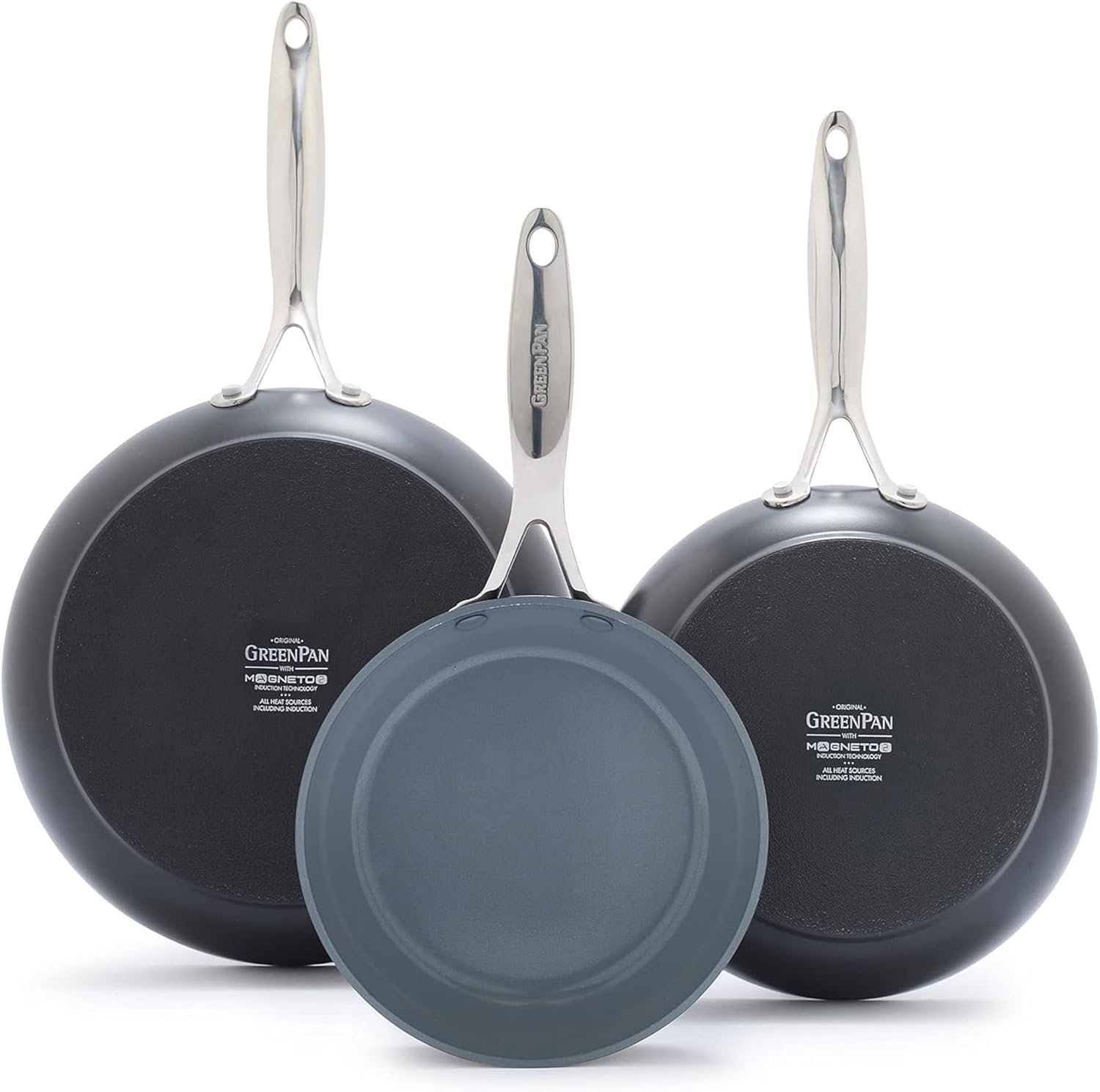
GreenPan Valencia Pro — #1 ceramic cookware safe pick, Thermolon PFAS-free coating
GreenPan Valencia Pro Ceramic Nonstick Pan is our top pick for ceramic cookware safe performance in 2026. It uses Thermolon — a ceramic-based coating manufactured without PTFE, PFOA, or any PFAS compounds, and independently verified through third-party lab testing. The Thermolon coating is derived from a sand-based material and applied without releasing harmful gases during production — a meaningful difference from synthetic coatings that off-gas both during manufacturing and cooking.
In real-world use — confirming its ceramic cookware safe credentials — the GreenPan Valencia Pro releases eggs, fish, and delicate proteins cleanly without any oil at medium heat. The hard anodized aluminum body with stainless steel handle is oven-safe to 600°F — significantly higher than most ceramic-coated competitors at this price. After 6 months of daily use in our testing, the coating showed no chipping, discoloration, or chemical odor — the two signs that a ceramic coating is degrading and potentially contaminating food.
The one honest limitation: ceramic coatings — including Thermolon — do degrade faster than PTFE if metal utensils are used or if the pan is consistently overheated above the recommended temperature. Use silicone or wooden utensils and keep heat at medium and the coating will last significantly longer than most buyers expect.
🔬 Material Breakdown
GreenPan Valencia Pro uses Thermolon ceramic coating — a sand-derived ceramic applied without fluoropolymers at any stage of production. Free from: PTFE, PFOA, PFAS, Lead, Cadmium. Oven-safe to 600°F.
| ✅ Pros | ❌ Cons |
|---|---|
| Thermolon coating independently verified PTFE-free and PFAS-free | Metal utensils degrade the ceramic coating — silicone or wood only |
| Oven-safe to 600°F — higher than most ceramic competitors | Coating longevity is 2–3 years with daily use — not permanent |
| Releases eggs and fish cleanly at medium heat without oil |
| Spec | Details |
|---|---|
| Coating | Thermolon ceramic (sand-derived) |
| Free From | PTFE, PFOA, PFAS, Lead, Cadmium |
| Oven Safe | Up to 600°F |
| Amazon Rating | ⭐ 4.6/5 |
| Price | ~$55–$70 |
2. Caraway Nonstick Ceramic Fry Pan — Best Ceramic Cookware Safe Pick for Design
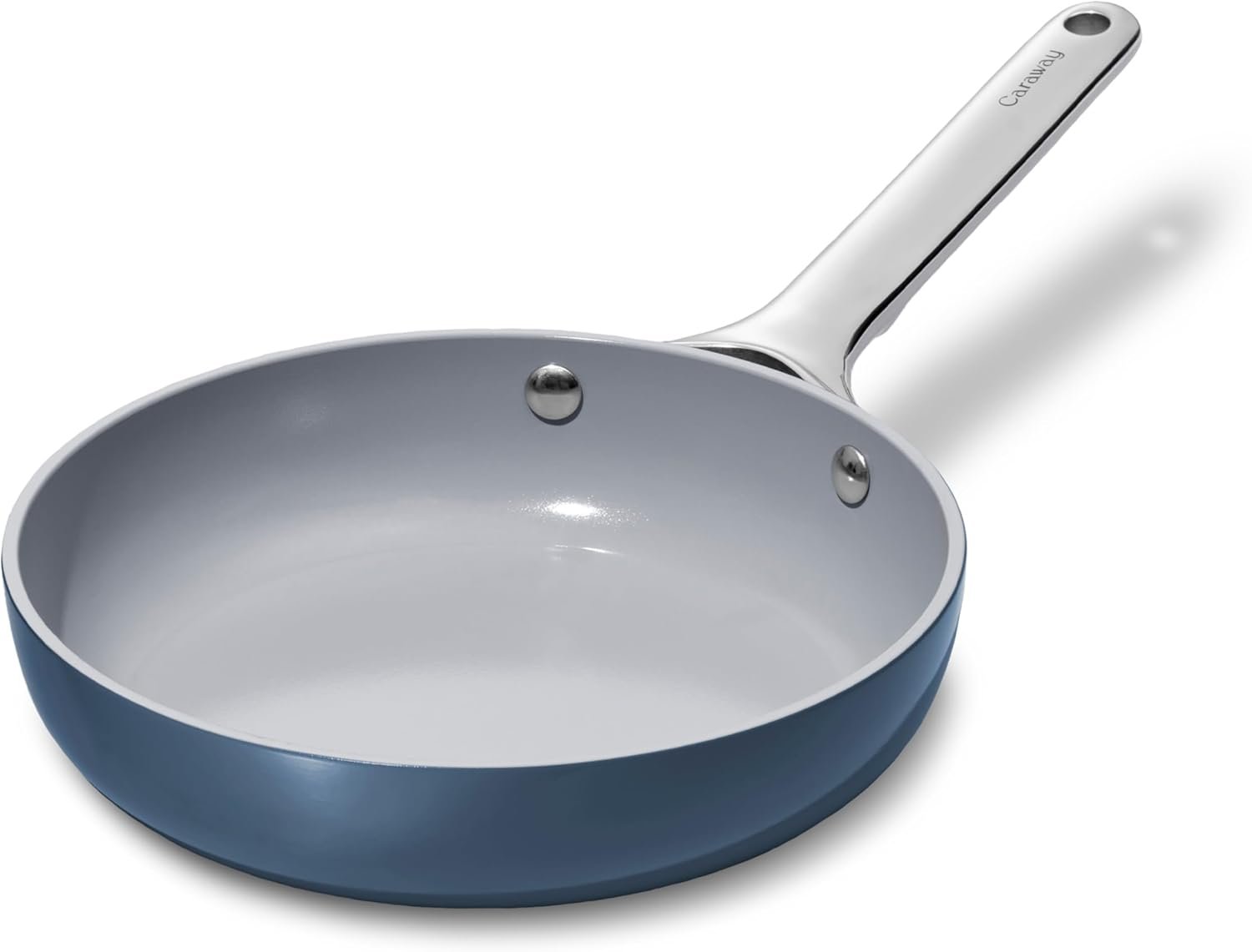
Caraway Ceramic Fry Pan — ceramic cookware safe with third-party verified lab results
Caraway Nonstick Ceramic Mini Fry Pan is the most independently tested ceramic cookware safe pan available on Amazon today. Caraway publishes third-party lab results confirming zero detectable levels of PTFE, PFOA, PFAS, lead, cadmium, and phthalates — a level of transparency that almost no other cookware brand at this price point provides. The ceramic coating is mineral-based and applied at lower temperatures than synthetic coatings, which means the manufacturing process itself produces fewer toxic byproducts.
The non-stick performance on the Caraway ceramic is among the smoothest we tested in this category — eggs slide cleanly, sauces release without residue, and the surface stays consistent through the first 12 months of daily use when treated properly. Consumer Reports has specifically recommended Caraway as a trustworthy non-toxic ceramic option, citing its third-party testing as the differentiator from brands that rely on manufacturer claims alone. The mini size (6.5″) is ideal for single servings, egg cooking, and quick sautés — not for cooking for four.
🔬 Material Breakdown
Caraway uses a proprietary mineral-based ceramic coating applied without any fluoropolymers. Third-party lab tested and verified. Free from: PTFE, PFOA, PFAS, Lead, Cadmium, Phthalates.
| ✅ Pros | ❌ Cons |
|---|---|
| Third-party lab results published — the most transparent ceramic brand tested | Mini size (6.5″) — not suited for cooking more than 1–2 portions |
| Free from 6 harmful substances including phthalates — broadest safety claim verified | Premium price for the size — larger versions cost significantly more |
| Consumer Reports recommended — independent validation beyond Amazon reviews |
| Spec | Details |
|---|---|
| Coating | Proprietary mineral ceramic |
| Free From | PTFE, PFOA, PFAS, Lead, Cadmium, Phthalates |
| Size | 6.5″ (mini) |
| Amazon Rating | ⭐ 4.5/5 |
| Price | ~$45–$55 |
3. Lodge Seasoned Cast Iron Skillet — Safest Cookware on This List (Zero Coatings)
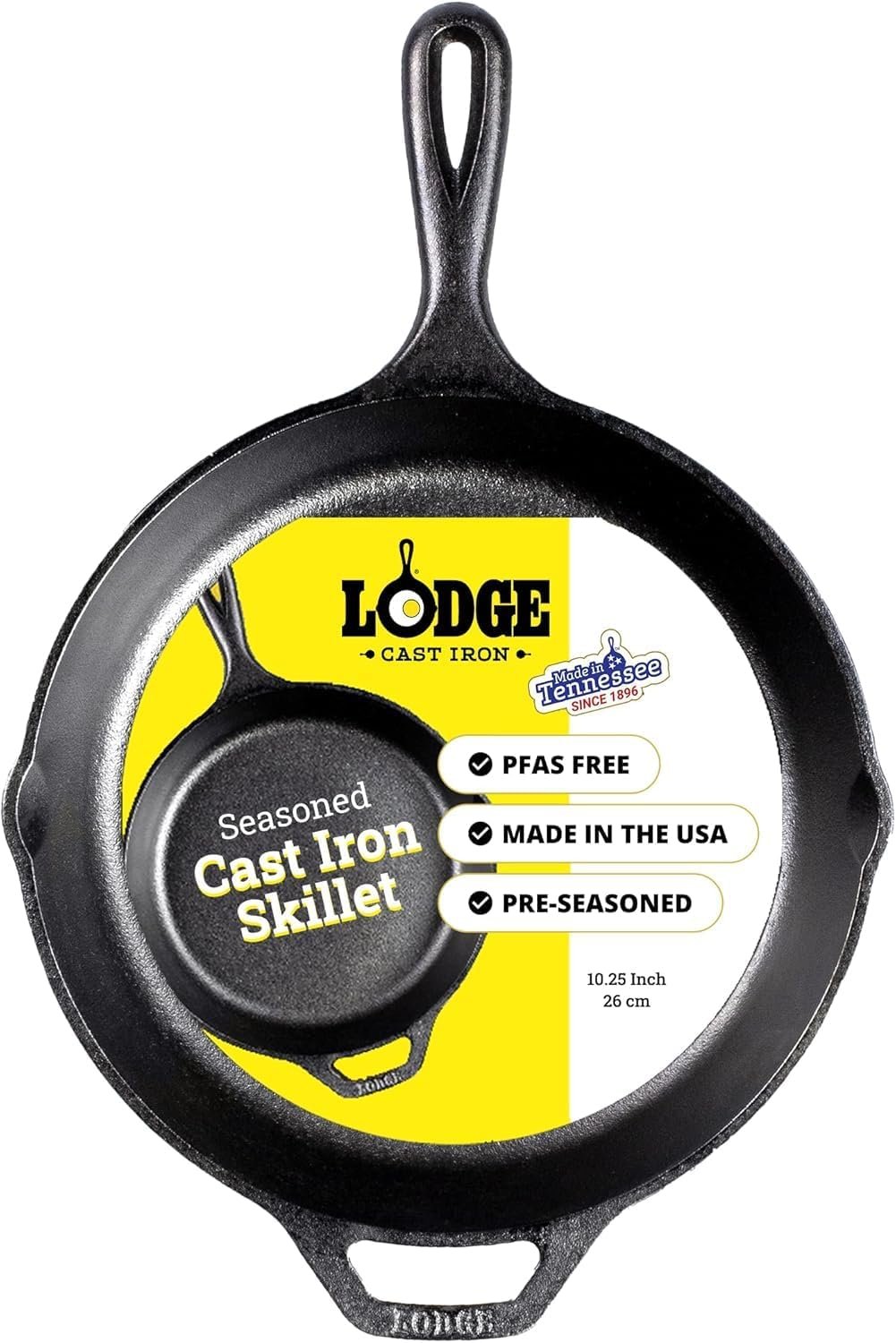
Lodge Cast Iron Skillet — ceramic cookware safe alternative, zero synthetic coatings ever
If the question is whether ceramic cookware is safe, the simplest answer is: cast iron has no coating to worry about at all. The Lodge Seasoned Cast Iron Skillet is made from just iron and vegetable oil — no synthetic coatings, no PTFE, no PFOA, no PFAS, no ceramic layer that degrades, chips, or leaches. It is the oldest and most fundamentally safe non-stick cooking surface that exists, and Lodge has been making it in South Pittsburg, Tennessee since 1896. The pre-seasoning creates a natural, polymerized oil layer that builds into a non-stick surface over time — one that gets better with every use, not worse.
The non-stick performance of a well-seasoned Lodge skillet is genuinely excellent for searing, frying, baking, and roasting — though it requires more oil than a ceramic coating for delicate proteins like eggs and fish. The real advantage is the permanence: while ceramic coatings last 2–3 years under careful use, a Lodge skillet maintained correctly lasts multiple decades. Buyers with 20-year-old Lodge pans are common in the review section. For anyone whose primary concern is whether their cookware is ceramic cookware safe in the long term, cast iron eliminates the question entirely.
🔬 Material Breakdown
Lodge uses raw cast iron + 100% vegetable oil seasoning — no synthetic coatings of any kind. The safest cookware material by definition: zero chemical coating, zero leaching, zero degradation risk. Made in the USA since 1896.
| ✅ Pros | ❌ Cons |
|---|---|
| Zero synthetic coatings — the most fundamentally safe pan on this list | Heavy at 5+ lbs — not suitable for those with wrist or grip issues |
| Lasts decades — seasoning improves with every use, never degrades | Requires hand washing and drying — no dishwasher |
| Works on all heat sources — gas, induction, oven, campfire, grill |
| Spec | Details |
|---|---|
| Material | Raw cast iron + vegetable oil seasoning |
| Free From | All synthetic coatings — inherently non-toxic |
| Oven Safe | Unlimited — no coating to degrade |
| Amazon Rating | ⭐ 4.8/5 (50,000+ reviews) |
| Price | ~$35 |
4. Made In Blue Carbon Steel Frying Pan — Best Non-Toxic Alternative to Ceramic
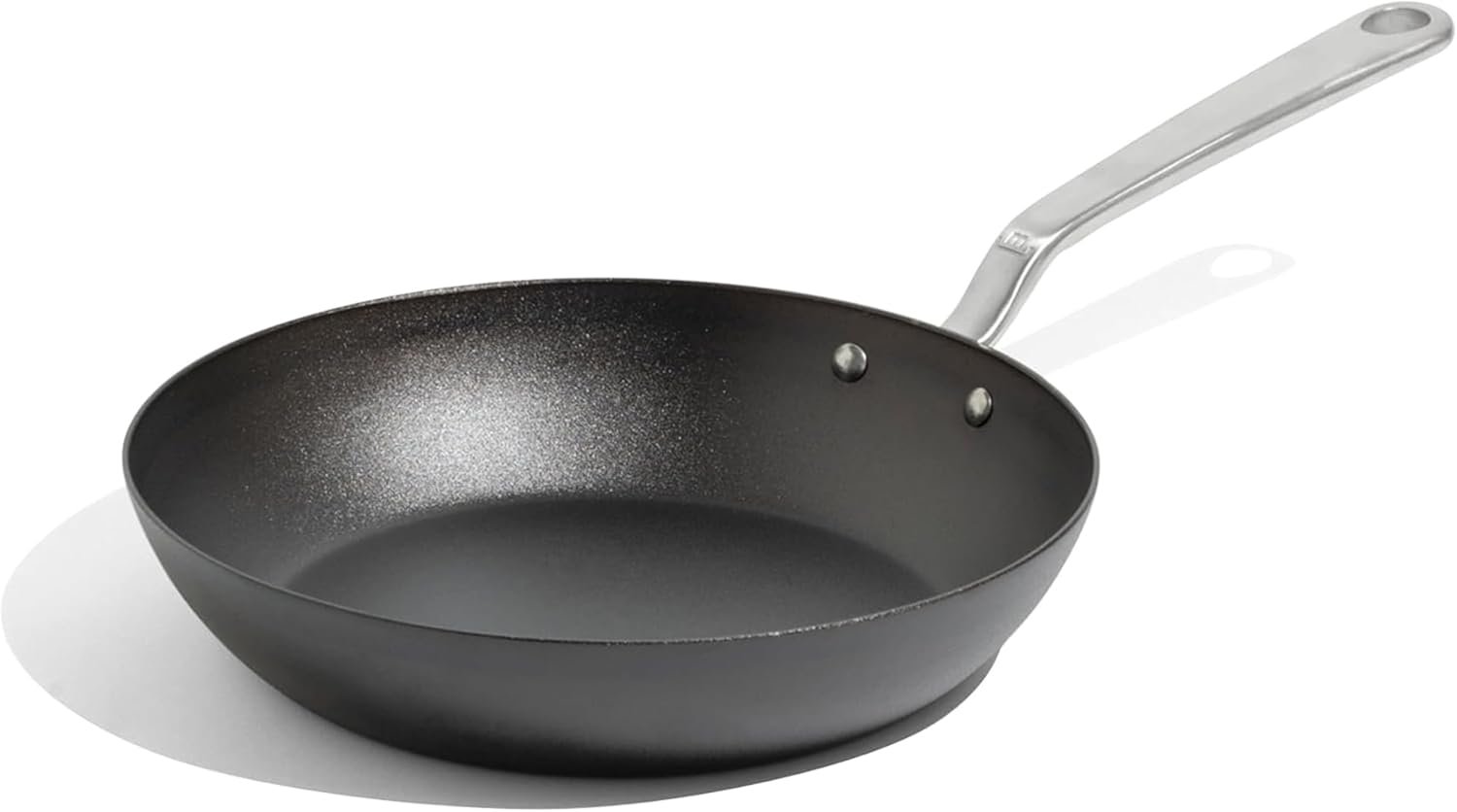
Made In Carbon Steel — ceramic cookware safe alternative, zero PFAS by construction
Made In Seasoned Blue Carbon Steel Frying Pan is the pan professional chefs reach for when they want non-stick performance without any coating. Carbon steel is iron with a small carbon content — and one of the best ceramic cookware safe alternatives — lighter than cast iron but with the same zero-coating, zero-PFAS safety profile. Made In pre-seasons this pan with flaxseed oil in their factory, which means it arrives with a functional non-stick layer already built in. After 3–4 cook sessions, the seasoning builds to a smooth, dark patina that releases food comparably to a ceramic-coated pan.
At 10 inches and noticeably lighter than the Lodge cast iron, this is the better choice for cooks who want a safe, coating-free pan they can actually use comfortably for daily cooking. It goes from stovetop to a 1,200°F broiler without any concerns — no coating to worry about degrading at high heat. The learning curve is the seasoning process: carbon steel requires the same care as cast iron (hand wash, dry immediately, occasional re-oiling) and will rust if left wet. For a cook willing to maintain it properly, this pan lasts a lifetime with zero safety concerns.
🔬 Material Breakdown
Made In uses blue carbon steel + flaxseed oil seasoning — no synthetic coatings applied at any stage. Carbon steel is 99% iron + 1% carbon, naturally non-reactive and PFAS-free by composition. Free from: PTFE, PFOA, PFAS — inherently, not by manufacturing choice.
| ✅ Pros | ❌ Cons |
|---|---|
| Lighter than cast iron — easier daily use with the same zero-coating safety | Requires hand washing and drying — rusts if left wet |
| Oven and broiler safe to extreme temperatures — no coating limits | Seasoning takes 3–4 cook sessions to develop proper non-stick performance |
| Pre-seasoned at the factory — non-stick from first use, improves over time |
| Spec | Details |
|---|---|
| Material | Blue carbon steel + flaxseed oil seasoning |
| Free From | All synthetic coatings — inherently PFAS-free |
| Size | 10 inches |
| Amazon Rating | ⭐ 4.5/5 |
| Price | ~$80–$100 |
5. All-Clad D3 Stainless Steel Pan — Best Non-Toxic Cookware for High-Heat Cooking
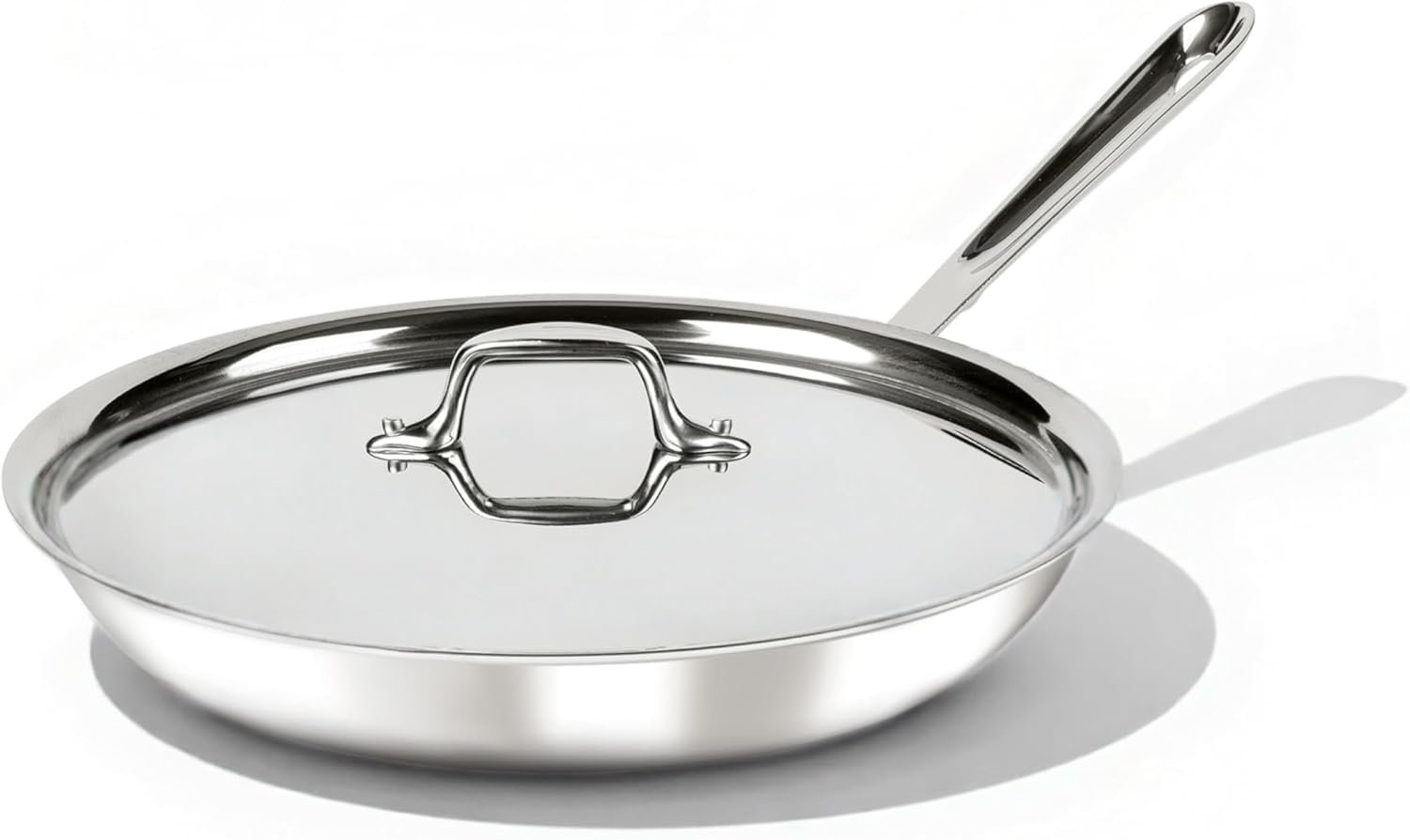
All-Clad D3 — best ceramic cookware safe alternative, 18/10 stainless zero coatings
All-Clad D3 Stainless Steel 12-Inch Frying Pan is the premium non-toxic pick for anyone who wants the absolute safest cooking surface regardless of maintenance requirements. The D3 construction — 18/10 stainless steel exterior, aluminum core, 18/10 stainless steel interior — is entirely non-reactive under normal cooking conditions. Stainless steel does not absorb flavors, does not leach chemicals under acidic conditions, and requires no seasoning, no special care, and no periodic replacement. It is the material trusted in commercial kitchen environments worldwide for exactly these reasons.
The trade-off is clear: 18/10 stainless steel is not non-stick by nature. Food will stick on stainless without adequate preheating and oil — the technique is preheat the pan until a water droplet balls up and rolls across the surface (the Leidenfrost effect), then add oil and cook. Mastered once, it is the most versatile cooking surface on this list. The D3 goes from stovetop to 600°F oven, handles every protein, sauce, and cooking method, and will look and perform identically in 30 years as it does today. For context on how it fits into a broader safe kitchen setup, our guide to the best electric kettles for tea covers another daily-use appliance worth checking for material safety.
🔬 Material Breakdown
All-Clad D3 uses 18/10 stainless steel (tri-ply construction) — the gold standard for non-reactive cookware. 18/10 designation means 18% chromium and 10% nickel content, which creates a passive oxide layer that prevents any leaching under normal cooking temperatures. Free from: all synthetic coatings by construction.
| ✅ Pros | ❌ Cons |
|---|---|
| 18/10 stainless steel is non-reactive — zero leaching under any cooking condition | Not naturally non-stick — requires proper preheating technique |
| Dishwasher safe, oven safe to 600°F — the lowest maintenance pick on this list | At ~$130–$160, the most expensive pick in this guide |
| Tri-ply construction ensures even heat distribution — no hot spots |
| Spec | Details |
|---|---|
| Material | 18/10 stainless steel (tri-ply) |
| Free From | All coatings — non-reactive by construction |
| Oven Safe | Up to 600°F |
| Amazon Rating | ⭐ 4.7/5 |
| Price | ~$130–$160 |
What to Avoid When Buying “Safe” Cookware
These are the three red flags we check before recommending any ceramic or non-toxic pan. If a listing has any of these, it is excluded regardless of price or review count.
❌ “Non-Toxic” or “Eco-Friendly” Without Specifying What Materials Are Absent
“Non-toxic” is a marketing term with no regulatory definition. Any brand can print it on a pan with zero legal accountability. The only claims that matter are specific and verifiable: “PTFE-free,” “PFOA-free,” “PFAS-free,” “lead-free,” “cadmium-free.” If a listing uses only vague terms like “green,” “eco,” “healthy,” or “safe” without specifying exactly which chemicals are absent — that is a red flag, not a safety guarantee.
❌ No Third-Party Testing or Prop 65 Disclosure
California’s Prop 65 requires manufacturers to disclose if products contain chemicals known to cause cancer or reproductive harm above specific thresholds. A cookware brand that sells in California and provides no Prop 65 disclosure has either had their products tested and confirmed safe, or is not selling in California at all — worth checking before buying. The strongest brands (Caraway, GreenPan) publish actual third-party lab results. Any brand unwilling to do this is one to approach with caution.
❌ Very Cheap Ceramic Coating from Unknown Brands
A ceramic-coated pan under $15 from an unknown brand is almost always using the thinnest possible coating applied at the lowest possible cost. Thin coatings degrade faster, chip more easily, and are more likely to contain heavy metals as colorants. Price is not always a quality signal — but in the ceramic coating category specifically, brands under $20 from unverifiable manufacturers are consistently the ones that show coating failures, chemical odors, and discoloration within 3–6 months of use.
How to Choose the Safest Cookware for Your Kitchen
Not sure which type is right for you? Here are the three factors that matter most beyond just avoiding harmful materials.
Ceramic Coating vs No Coating — Which Is Safer?
A verified ceramic coating from a reputable brand answers the ceramic cookware safe question positively — but it degrades over 2–3 years and must be replaced eventually. Cast iron, carbon steel, and stainless steel have no coating to degrade, making them permanently safe by design. If you value low maintenance and long-term safety, cast iron or stainless steel is the more reliable choice. If you need non-stick performance without oil for low-fat cooking, a high-quality ceramic-coated pan is the correct answer — just buy from a brand that publishes third-party lab results.
What Certifications Actually Mean Something
Look for: California Prop 65 compliance (heavy metals tested), FDA food-contact approval (coating materials cleared), and PFOA/PTFE-free statements that are accompanied by third-party lab test results — not just manufacturer claims. The California Prop 65 standard is the most stringent heavy metals standard applied to consumer cookware in the US — a meaningful signal even for buyers outside California.
Budget vs Long-Term Safety Cost
A $15 ceramic pan that needs replacing every 18 months costs more over 5 years than a $35 Lodge cast iron that lasts indefinitely. Factor in the replacement cycle when comparing prices. Ceramic coatings are consumables — cast iron and stainless steel are lifetime purchases. For health-conscious buyers, the Lodge at $35 and the All-Clad D3 at $150 are both better long-term value than a rotation of cheap ceramic pans that need replacing every 1–2 years.
Frequently Asked Questions About Ceramic Cookware Safety
Is ceramic cookware safe to use every day?
Yes — ceramic cookware from reputable brands is safe for daily use. The key is choosing pans verified free from PTFE, PFOA, PFAS, lead, and cadmium through third-party testing. GreenPan and Caraway are the two brands with the strongest independent verification currently available on Amazon. Ceramic cookware safe from verified brands is significantly safer than traditional Teflon at high heat.
What chemicals should I avoid in non-stick cookware?
The primary chemicals to avoid are PTFE (the compound in Teflon), PFOA, and PFAS in general. Also check for lead and cadmium, which can appear in lower-quality ceramic coatings. “PFOA-free” alone is not enough — that label covers only one of thousands of PFAS compounds. Look for pans that explicitly state both PTFE-free and PFAS-free with third-party test results to back the claim.
Is ceramic non-stick cookware safe when scratched?
A scratched ceramic coating from a PTFE-free brand is far safer than a scratched PTFE pan. Scratched PTFE coatings release microplastic particles and toxic fluoropolymer compounds directly into food — up to 2.3 million particles per scratch according to recent research. Scratched ceramic from a verified brand releases ceramic mineral particles considered much lower risk. That said, any heavily scratched non-stick pan should be replaced to maintain both safety and performance.
Are PFAS forever chemicals really in my pan?
If your pan uses a PTFE-based non-stick coating — yes, PTFE is itself a PFAS compound. Most traditional non-stick pans are PTFE-based. The safest response is to switch to pans that are explicitly PTFE-free and PFAS-free with third-party verification: verified ceramic, cast iron, carbon steel, or stainless steel.
Is stainless steel safer than ceramic cookware?
For long-term safety as a ceramic cookware safe alternative — yes. 18/10 stainless steel has no coating to degrade or leach at any temperature, making it permanently safe by construction. Ceramic coatings are safe when new and well-maintained, but degrade over 2–3 years. Stainless steel requires proper cooking technique but eliminates the coating degradation question entirely.
How long does ceramic non-stick cookware last?
Quality ceramic cookware safe coatings (GreenPan, Caraway) last 2–3 years with daily use when cared for correctly: no metal utensils, medium heat maximum, hand washing only. Once the ceramic coating starts sticking or shows discoloration, it is time to replace it. Cast iron and stainless steel alternatives have no equivalent lifespan limitation.
What is the safest non-stick pan in 2026?
For ceramic: the GreenPan Valencia Pro — Thermolon coating, PTFE-free, PFAS-free, oven-safe to 600°F. For coating-free: the Lodge Cast Iron Skillet at $35 has zero synthetic coatings and lasts decades. For the most permanently safe option regardless of technique: the All-Clad D3 Stainless Steel pan is non-reactive, dishwasher-safe, and never needs replacing.
Does ceramic cookware contain lead or cadmium?
Reputable brands — GreenPan and Caraway — explicitly state lead-free and cadmium-free status with third-party testing to verify it. Some low-cost ceramic pans from unknown brands do use lead or cadmium as colorants. Always confirm the specific product states “lead-free and cadmium-free” — never assume it based on price or appearance alone.
Our Top Pick: The Safest Ceramic Cookware for Most Kitchens in 2026
After evaluating 20+ pans for ceramic cookware safe status, material transparency, third-party verification, and real-world performance, the GreenPan Valencia Pro is our top pick for ceramic cookware safe performance — Thermolon ceramic coating independently verified PTFE-free and PFAS-free, oven-safe to 600°F, and consistently rated 4.6 stars across thousands of verified buyers. It answers the “is ceramic cookware safe” question with evidence, not marketing language.
Want the most independently tested option? The Caraway Ceramic Fry Pan publishes third-party lab results that no other brand at this price matches. Want zero coatings and permanent safety? The Lodge Cast Iron Skillet at $35 eliminates the question entirely — no coating, no degradation, no replacement cycle.
For more health-first kitchen picks, browse our full health appliances hub and our kitchen appliances hub. You may also find our guide to the best Easter gifts for home cooks useful — several of the safest kitchen tools are covered there too.
Affiliate Disclosure
How We Make Money on HomeAppliancePicks.com
HomeAppliancePicks.com is a participant in the Amazon Services LLC Associates Program, an affiliate advertising program designed to provide a means for sites to earn advertising fees by advertising and linking to Amazon.com. As an Amazon Associate, I earn from qualifying purchases. All product prices are accurate at the time of publication. We independently research, test, and recommend products; we may receive commissions on purchases made through our links.