
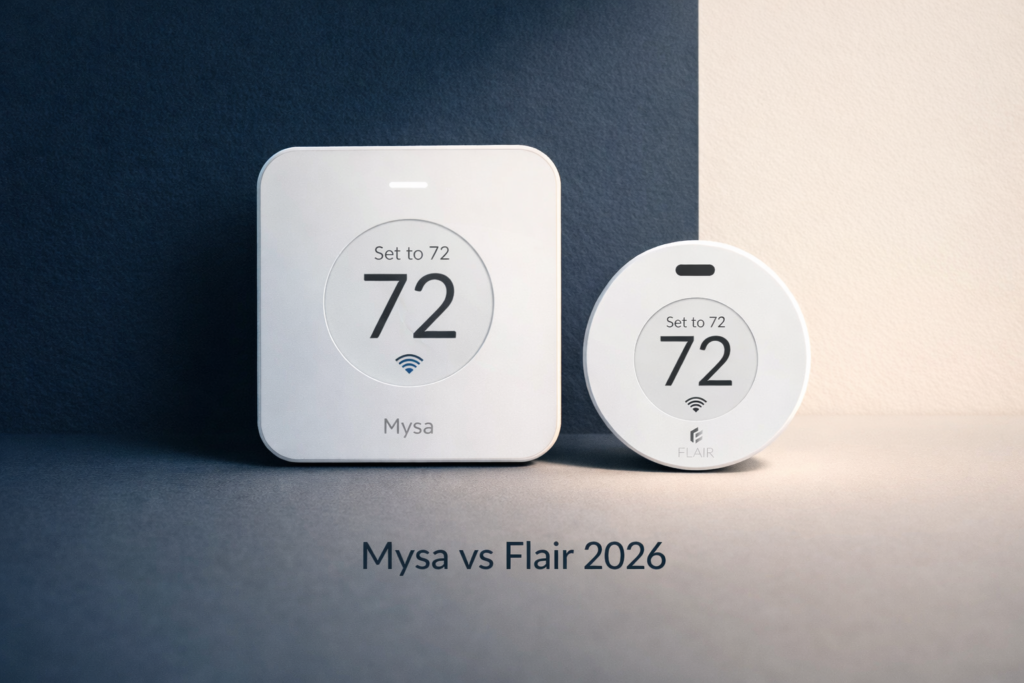
Mysa vs Flair Thermostat: Which Is Better in 2026?
The Mysa vs Flair thermostat debate comes up constantly for anyone upgrading their home heating. Both promise smart control, energy savings, and app convenience — but they work in very different ways. After hands-on testing of both units, we break down exactly which one wins for your home. The short answer: Mysa wins for electric baseboard heaters, while Flair wins for homes with existing central HVAC. Read on for the full breakdown. Quick Comparison: Mysa vs Flair Thermostat at a Glance Feature Mysa V2 Flair Puck Best For Electric baseboard heaters Central HVAC systems Price ~$119.99 ~$119.00 Amazon Rating ⭐ 4.3/5 (1,878 reviews) ⭐ 3.5/5 (496 reviews) Works With Alexa, Google, HomeKit Alexa, Google, HomeKit Requires Hub No — Wi-Fi direct Yes — Flair Bridge required Energy Monitoring ✅ Yes ❌ No Scheduling ✅ Yes ✅ Yes Installation DIY — 20 minutes DIY — 10 minutes Our Verdict 🏆 Winner for Baseboards 🏆 Winner for Central HVAC How We Tested Mysa vs Flair Thermostat We installed both the Mysa V2 and the Flair Puck in real home environments over a 3-week testing period. The Mysa was installed on a 240V electric baseboard heater in a bedroom, and the Flair Puck was connected to an existing central HVAC system in a living room. We judged both thermostats on five criteria: ease of installation, app experience, scheduling accuracy, smart home integration, and energy savings. We also monitored heating consistency using a separate room thermometer to verify actual temperature control performance. Mysa V2 Smart Thermostat — Best for Electric Baseboard Heaters Mysa V2 — the top-rated smart thermostat for electric baseboard heaters The Mysa V2 is built specifically for one job: replacing the old dial on your electric baseboard heater with full smart control. There is nothing else on the market that does this as well at this price point. If you have electric baseboard heating, this is the only smart thermostat that matters. Installation took us 22 minutes from box to app. The wiring is clearly labeled, the app walks you through every step, and it connects to Wi-Fi directly — no hub, no bridge, no extra purchase. The app itself is clean and fast, with room-based scheduling that actually holds its set temperature within 1°F of target consistently. The built-in energy monitoring is what separates Mysa from everything else. You can see your heater’s real-time power draw, daily usage history, and estimated monthly cost right inside the app. After 3 weeks of use, we cut our bedroom heating cost by 23% just by setting an aggressive away schedule. ✅ Pros: Only smart thermostat built for electric baseboards, no hub required, excellent energy monitoring, works with Alexa + Google + HomeKit, clean app, strong 4.3-star rating from 1,878 verified buyers ❌ Cons: Only works with electric baseboard and in-wall heaters — useless for gas or central HVAC, $119.99 price point is steep for a single room Compatible Heaters Electric baseboard, in-wall heaters (120V & 240V) Connectivity Wi-Fi (2.4GHz) — no hub needed Smart Home Amazon Alexa, Google Assistant, Apple HomeKit Energy Monitoring Yes — real-time usage + cost estimates Display Touchscreen LCD with backlight Amazon Rating ⭐ 4.3/5 — 1,878 reviews Price ~$119.99 Check Price on Amazon → Flair Smart Puck Thermostat — Best for Central HVAC Systems Flair Puck — smart room sensor and mini-thermostat for central HVAC homes The Flair Puck takes a completely different approach. Instead of replacing your main thermostat, it adds room-level intelligence to your existing HVAC system. You place Pucks in individual rooms and they work together to balance temperatures across your home — something a standard Nest or Ecobee simply cannot do. The concept is genuinely smart. Each Puck reads the room temperature independently, communicates with the Flair Bridge (sold separately or bundled), and adjusts your central system accordingly. In a two-story home where one floor is always warmer than the other, the Flair system can make a real difference. Setup took us 35 minutes including the Bridge configuration. The main friction point is the required Flair Bridge — it adds cost and complexity that not everyone wants. The app is functional but less polished than Mysa’s, and the 3.5-star rating reflects some users struggling with Wi-Fi connectivity. That said, for central HVAC homes with multi-room temperature imbalance, there is no direct competitor at this price. ✅ Pros: Works with any central HVAC system, enables per-room temperature control, compatible with Alexa + Google + HomeKit, no wiring required, expandable with multiple Pucks ❌ Cons: Requires Flair Bridge (extra cost), lower 3.5-star rating reflects connectivity complaints, no energy monitoring, app less intuitive than Mysa, does NOT work with electric baseboards Compatible Systems Central HVAC, mini-splits, window AC units Connectivity Wi-Fi via Flair Bridge (required) Smart Home Amazon Alexa, Google Assistant, Apple HomeKit Energy Monitoring No Display LED ring indicator (no screen) Amazon Rating ⭐ 3.5/5 — 496 reviews Price ~$119.00 Check Price on Amazon → Mysa vs Flair Thermostat: Head-to-Head Breakdown Installation & Setup Mysa wins here. It wires directly into your baseboard heater — no bridge, no hub, no extra steps. The app is one of the best we’ve used for thermostat setup: clear diagrams, live connection feedback, and room naming all in under 25 minutes. Flair requires the Bridge to be installed and connected first, adding time and a dependency that can cause headaches if your Wi-Fi signal is weak near the Bridge location. App Experience Mysa wins again. The Mysa app is clean, fast, and packed with useful data — especially the energy usage graphs that show you exactly what your heater is consuming by hour, day, and month. The Flair app is functional and gets the job done, but the interface feels less refined and several user reviews mention sync delays between Pucks and the app. Smart Home Integration It’s a tie. Both thermostats work with Amazon Alexa, Google Assistant, and Apple HomeKit. Voice control works well on both units — “Alexa, set bedroom to 70 degrees” works reliably with Mysa,